
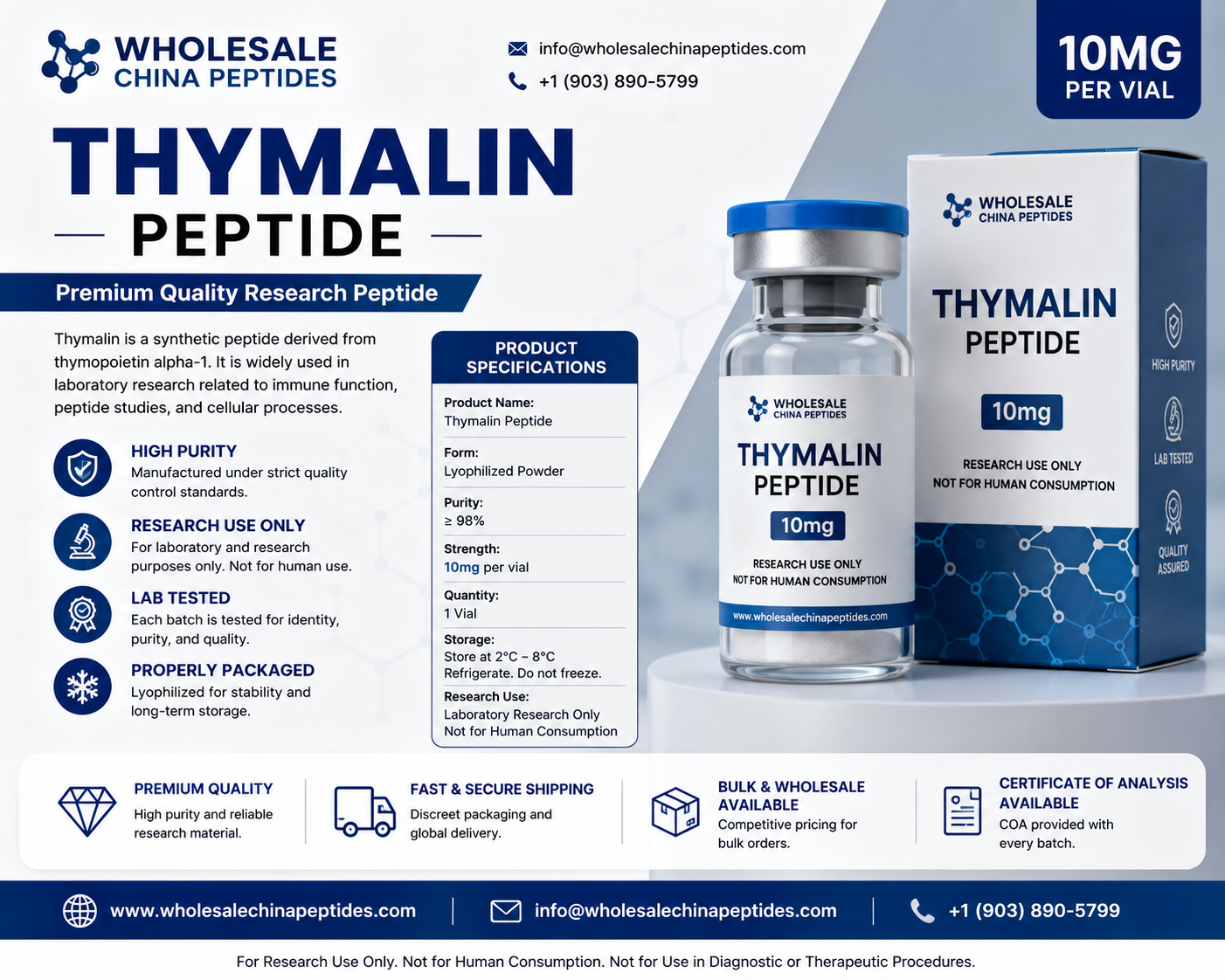
Thymalin Peptide
$80.00
Thymalin Peptide: Chemical Composition & Structure
Thymalin is a complex of low-molecular-weight peptides (primarily 2-5 kDa) extracted from bovine thymus tissue. Unlike synthetic peptides, thymalin contains multiple bioactive fractions that work synergistically.
Primary Components of Thymalin:
| Fraction | Molecular Weight | Key Functions |
|---|---|---|
| Thymalin A | ~2-3 kDa | Stimulates T-cell differentiation |
| Thymalin B | ~3-5 kDa | Enhances macrophage and NK cell activity |
| Thymic Humoral Factor (THF) | ~3-4 kDa | Regulates immune cell communication |
Chemical Properties:
| Property | Details |
|---|---|
| Solubility | Water-soluble (reconstitute with bacteriostatic water) |
| Storage (Lyophilized) | -20°C (stable for 2+ years) |
| Storage (Reconstituted) | 2-8°C (stable for 7-14 days) |
| Half-Life | ~4-6 hours (varies by administration route) |
| Purity | ≥95% (HPLC-verified) |
Where to Buy High-Quality Thymalin Peptide for Research
For researchers seeking pharmaceutical-grade thymalin peptide, Wholesale China Peptides offers:
✅ ≥95% Purity (HPLC-verified)
✅ Lyophilized for long-term stability
✅ Batch-specific COAs (Certificate of Analysis)
✅ Bulk & wholesale pricing for institutions
✅ Secure, discreet shipping worldwide
Note: Thymalin peptide is for research use only—not for human consumption, medical treatment, or performance enhancement.
Thymalin Peptide: A Comprehensive Research Guide
Introduction to Thymalin Peptide
Thymalin is a naturally occurring thymic peptide derived from the thymus gland, playing a crucial role in immune regulation, cellular repair, and anti-aging mechanisms. Unlike synthetic immunomodulators, thymalin is a bioregulatory peptide that helps restore thymic function, making it a valuable tool in immunology, gerontology, and regenerative medicine research.
At Wholesale China Peptides, researchers can access high-purity thymalin peptide for controlled laboratory studies. This 1000+ word guide covers everything scientists need to know about thymalin peptide, including its chemical composition, mechanisms of action, research benefits, dosage protocols, and safety considerations.
What Is Thymalin Peptide?
Thymalin is a polypeptide complex extracted from the thymus gland of calves, consisting of two main fractions (Thymalin A and Thymalin B). It was first developed in Russia as an immunomodulatory drug and has since been studied for its potential in immune restoration, anti-aging, and disease prevention.
Key Features of Thymalin Peptide:
✅ Restores thymic function – Supports T-cell maturation and immune balance.
✅ Enhances immune response – Boosts natural killer (NK) cell and macrophage activity.
✅ Anti-aging effects – May slow thymic involution (age-related thymus shrinkage).
✅ Neuroprotective properties – Studied in Alzheimer’s and Parkinson’s models.
✅ Wound healing & tissue repair – Accelerates cellular regeneration.
Thymalin Peptide: Chemical Composition & Structure
Thymalin is a complex of low-molecular-weight peptides (primarily 2-5 kDa) extracted from bovine thymus tissue. Unlike synthetic peptides, thymalin contains multiple bioactive fractions that work synergistically.
Primary Components of Thymalin:
| Fraction | Molecular Weight | Key Functions |
|---|---|---|
| Thymalin A | ~2-3 kDa | Stimulates T-cell differentiation |
| Thymalin B | ~3-5 kDa | Enhances macrophage and NK cell activity |
| Thymic Humoral Factor (THF) | ~3-4 kDa | Regulates immune cell communication |
Chemical Properties:
| Property | Details |
|---|---|
| Solubility | Water-soluble (reconstitute with bacteriostatic water) |
| Storage (Lyophilized) | -20°C (stable for 2+ years) |
| Storage (Reconstituted) | 2-8°C (stable for 7-14 days) |
| Half-Life | ~4-6 hours (varies by administration route) |
| Purity | ≥95% (HPLC-verified) |
How Thymalin Peptide Works: Mechanisms of Action
Thymalin exerts its effects by modulating thymic function and immune cell activity. Unlike synthetic drugs, it works naturally to restore immune homeostasis.
Step-by-Step Mechanism:
- Stimulates Thymic Epithelial Cells – Promotes thymopoiesis (T-cell production).
- Enhances T-Cell Maturation – Increases CD4+ and CD8+ T-cell counts.
- Boosts Natural Killer (NK) Cell Activity – Improves viral and tumor defense.
- Modulates Cytokine Production – Balances pro-inflammatory and anti-inflammatory signals.
- Supports Cellular Repair – Accelerates wound healing and tissue regeneration.
Why Thymalin is Unique Among Immunomodulators
- Natural origin (derived from thymus tissue).
- Broad-spectrum immune modulation (unlike single-target drugs).
- Minimal side effects (well-tolerated in research models).
- Potential anti-aging effects (may slow thymic involution).
Thymalin Peptide Benefits in Research
Thymalin is studied for its potential therapeutic applications, including:
1. Immune System Regulation & Restoration
- Restores thymic function in immunodeficient models.
- Enhances T-cell and NK cell activity (studies in cancer and viral infections).
- Reduces autoimmune reactions (potential for lupus, rheumatoid arthritis).
2. Anti-Aging & Longevity Research
- Slows thymic involution (age-related thymus shrinkage).
- Improves immune resilience in elderly animal models.
- May extend lifespan (studies in gerontology research).
3. Neuroprotection & Cognitive Function
- Reduces neuroinflammation (studies in Alzheimer’s and Parkinson’s models).
- Enhances neuronal repair (potential for stroke and TBI recovery).
- Improves cognitive function in aging models.
4. Wound Healing & Tissue Repair
- Accelerates skin regeneration (studies in burn and surgical wound models).
- Enhances collagen synthesis (potential for scar reduction).
- Supports muscle recovery (studies in sports injury models).
5. Infectious Disease & Cancer Research
- Boosts antiviral immunity (studies in HIV and hepatitis models).
- Enhances tumor surveillance (potential immunotherapy applications).
- Reduces sepsis-related mortality (studies in bacterial infection models).
Thymalin Peptide Dosage Protocols for Research
Since thymalin peptide is not approved for human use, dosage guidelines are based on preclinical and clinical research models. Researchers should adjust protocols based on study objectives.
General Dosage Guidelines
| Study Type | Dosage Range | Administration Route | Frequency |
|---|---|---|---|
| Immune Modulation | 5–20 mg/kg | Subcutaneous (SC) or Intramuscular (IM) | Daily for 5–10 days |
| Anti-Aging Research | 10–30 mg/kg | SC or IM | 2–3x per week for 4–8 weeks |
| Neuroprotection Studies | 15–40 mg/kg | Intraperitoneal (IP) or ICV (intracerebroventricular) | Daily for 7–14 days |
| Wound Healing | 10–25 mg/kg | Topical or SC | Daily for 5–14 days |
| Cancer & Infection Models | 20–50 mg/kg | SC or IV | Daily for 10–21 days |
Key Dosage Considerations
✔ Start with low doses (5–10 mg/kg) to assess immune response.
✔ Monitor cytokine levels (to avoid overstimulation).
✔ Use intermittent dosing for long-term studies (to prevent tolerance).
✔ Consider combination therapies (e.g., with epithalon for anti-aging research).
Potential Side Effects & Safety Considerations
While thymalin peptide is generally well-tolerated in research, potential side effects should be monitored:
Common Side Effects (Observed in Animal Models)
| Side Effect | Cause | Mitigation Strategy |
|---|---|---|
| Mild injection site irritation | Subcutaneous administration | Rotate injection sites |
| Transient fever | Immune activation | Monitor temperature, reduce dose if severe |
| Allergic reactions (rare) | Peptide sensitivity | Conduct patch testing before full dosing |
| Cytokine release syndrome (high doses) | Overstimulation of immune cells | Start with low doses, monitor cytokine levels |
Long-Term Considerations
⚠ Immune overactivation – Prolonged use may lead to autoimmune-like reactions.
⚠ Tolerance development – Long-term use may reduce efficacy.
⚠ Drug interactions – May enhance effects of immunosuppressants or vaccines.
Where to Buy High-Quality Thymalin Peptide for Research
For researchers seeking pharmaceutical-grade thymalin peptide, Wholesale China Peptides offers:
✅ ≥95% Purity (HPLC-verified)
✅ Lyophilized for long-term stability
✅ Batch-specific COAs (Certificate of Analysis)
✅ Bulk & wholesale pricing for institutions
✅ Secure, discreet shipping worldwide
Note: Thymalin peptide is for research use only—not for human consumption, medical treatment, or performance enhancement.
Conclusion: Why Thymalin Peptide is a Breakthrough in Immune & Anti-Aging Research
Thymalin peptide is one of the most promising bioregulatory peptides for immune modulation, anti-aging, and regenerative medicine research. Its natural origin, broad-spectrum immune effects, and minimal side effects make it a valuable tool for studying:
✔ Immune system restoration
✔ Anti-aging and longevity
✔ Neuroprotection and cognitive function
✔ Wound healing and tissue repair
✔ Infectious disease and cancer immunotherapy
For high-purity thymalin peptide at competitive prices, visit Wholesale China Peptides.
Disclaimer: This article is for educational and research purposes only. Thymalin peptide is not approved for human use and should only be used in IRB-approved laboratory settings.
Ready to Buy Thymalin Peptide for Research?
🔹 Visit Wholesale China Peptides
🔹 Request a COA before purchasing
🔹 Consult with a research advisor for proper dosing protocols
| Choose An Option | 10mg*10vials |
|---|
Be the first to review “Thymalin Peptide”
Related products

Healing & Recovery Peptides
Healing & Recovery Peptides

Healing & Recovery Peptides

Muscle & Performance Research Peptides

Growth Hormone Secretagogues

Healing & Recovery Peptides

Cognitive & Neurological Research Peptides
Anti-Aging & Longevity Research Peptides
Reviews
There are no reviews yet.