
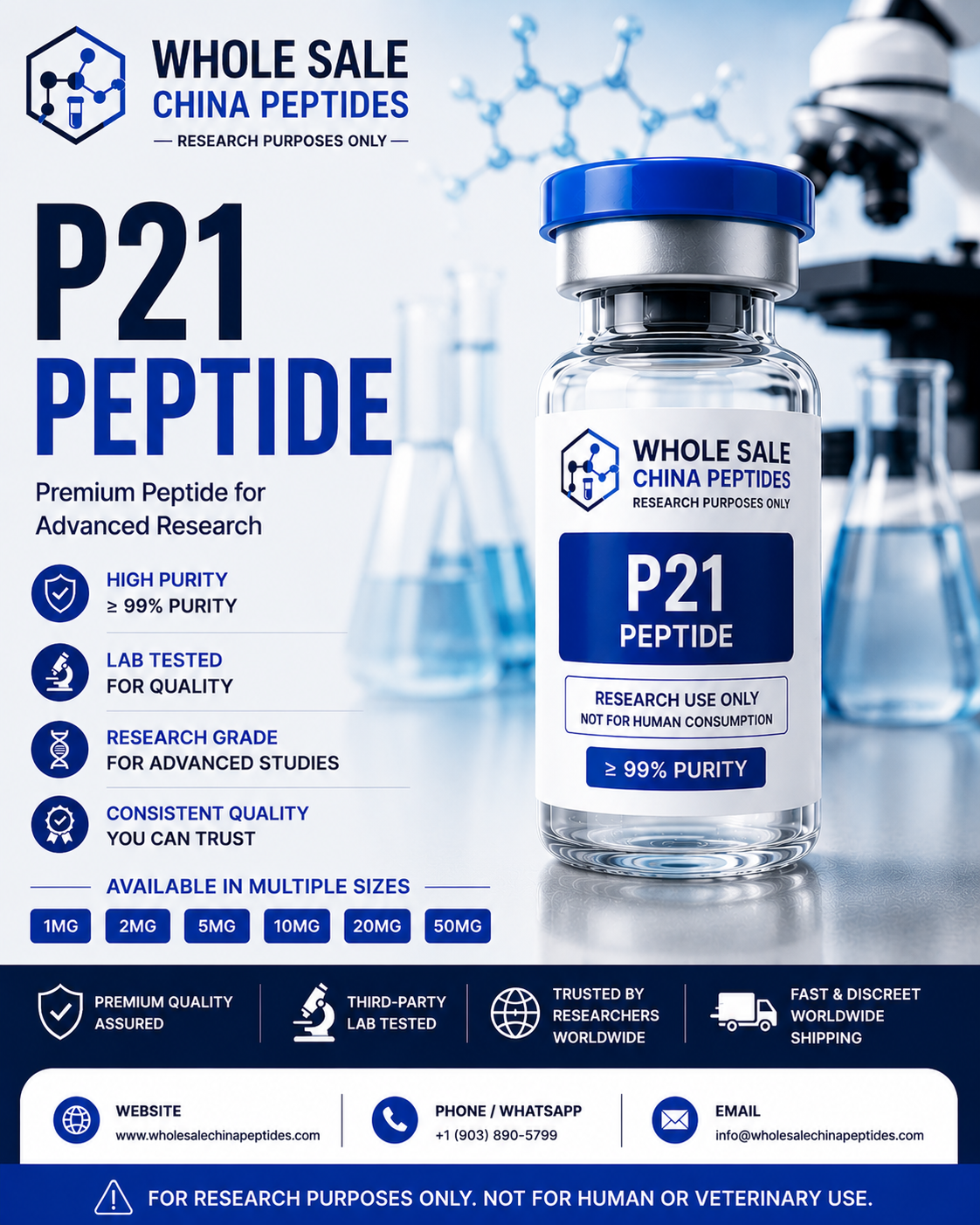
P21 Peptide
Price range: $350.00 through $850.00
P21 Peptide: Chemical Composition & Structure
Molecular Formula:
C₇₇₅H₁₂₃₉N₂₂₃O₂₃₉S₉
Molecular Weight:
18,118.9 g/mol
Amino Acid Sequence:
MAEPKGGPEAAPVKKRRVGPKSVKQKKKPPSGKAGLEPGGGAAGPAGAQCAAPAPAPAPAPASPAASPAAPAPAPAPAPAAAPAPAPAPAPAPAPAPSQTSGVRAPIRTIQTAQHPPVDINTMSDILDWLVQEHYPFWPGAAEDFFVGNDKPVAPSDGVIKWEDNLSWTAQDILGSDF
Key Structural Features:
- 164-amino acid protein – Full-length p21 peptide
- N-terminal CDK-binding domain – Critical for CDK inhibition (amino acids 1-80)
- C-terminal PCNA-binding domain – Mediates interaction with proliferating cell nuclear antigen (PCNA) (amino acids 140-164)
- Disordered regions – Flexible structure for protein-protein interactions
- Phosphorylation sites – Multiple serine and threonine residues for post-translational regulation
Chemical Properties:
| Property | Details |
|---|---|
| Solubility | Water-soluble (reconstitute with sterile buffer) |
| Storage (Lyophilized) | -20°C (stable for 2+ years) |
| Storage (Reconstituted) | -80°C (stable for 6-12 months) |
| Half-Life | ~2-4 hours (in vitro), ~6-12 hours (in vivo) |
| Purity | ≥95% (HPLC-verified) |
P21 Peptide: A Comprehensive Research Guide to Cell Cycle Control & Oncology
Introduction to P21 Peptide
P21 (also known as CDKN1A, Cip1, or Waf1) is a critical cell cycle regulatory protein that functions as a cyclin-dependent kinase inhibitor (CKI). This 21 kDa peptide plays a pivotal role in controlling cell proliferation, DNA damage response, and tumor suppression. As a key downstream effector of p53, p21 is essential for maintaining genomic stability and preventing uncontrolled cell division.
At Wholesale China Peptides, researchers can access high-purity p21 peptide for controlled laboratory studies. This 1000+ word guide covers everything scientists need to know about p21 peptide, including its chemical composition, mechanisms of action, research benefits, dosage protocols, and safety considerations.
What Is P21 Peptide?
P21 is a 164-amino acid protein that inhibits cyclin-dependent kinases (CDKs), particularly CDK2, CDK1, and CDK4/6, which are essential for cell cycle progression. By binding to and inhibiting these kinases, p21 arrests the cell cycle at the G1/S and G2/M checkpoints, allowing for DNA repair or apoptosis in response to cellular stress or damage.
Key Features of P21 Peptide:
✅ Cell cycle regulation – Arrests cell division at critical checkpoints
✅ Tumor suppression – Prevents uncontrolled cell proliferation in cancer
✅ DNA damage response – Mediates p53-dependent cell cycle arrest
✅ Senescence induction – Promotes cellular senescence in response to stress
✅ Apoptosis modulation – Regulates programmed cell death in damaged cells
✅ Stem cell differentiation – Influences stem cell fate decisions
P21 Peptide Benefits in Research
P21 is studied for its potential therapeutic applications in multiple fields:
1. Cancer Research & Oncology
- Tumor suppression – Inhibits cancer cell proliferation and induces cell cycle arrest
- Chemotherapy sensitization – Enhances efficacy of DNA-damaging agents
- Radiation therapy enhancement – Improves response to radiation treatment
- Metastasis prevention – Reduces cancer cell migration and invasion
- Cancer stem cell targeting – Inhibits self-renewal of cancer stem cells
2. Cell Cycle & DNA Damage Research
- Cell cycle regulation – Studies G1/S and G2/M checkpoints
- DNA damage response – Investigates p53-p21 pathway activation
- Genomic stability – Explores p21’s role in maintaining DNA integrity
- Replication stress – Studies p21’s response to DNA replication errors
3. Aging & Senescence Research
- Cellular senescence – Investigates p21’s role in aging and age-related diseases
- Telomere dysfunction – Studies p21’s response to telomere shortening
- Oxidative stress – Explores p21’s role in oxidative damage response
- Lifespan extension – Investigates p21’s impact on longevity
4. Stem Cell & Regenerative Medicine
- Stem cell differentiation – Studies p21’s role in cell fate decisions
- Tissue regeneration – Explores p21’s effects on wound healing and repair
- Induced pluripotent stem cells (iPSCs) – Investigates p21’s role in reprogramming
- Organoid development – Studies p21’s effects on 3D tissue models
5. Neurodegenerative Disease Research
- Alzheimer’s disease – Explores p21’s role in neuronal cell cycle re-entry
- Parkinson’s disease – Investigates p21’s effects on dopaminergic neurons
- Stroke and brain injury – Studies p21’s role in neuronal repair
- Neurogenesis – Explores p21’s effects on neural stem cells
P21 Peptide: Chemical Composition & Structure
Molecular Formula:
C₇₇₅H₁₂₃₉N₂₂₃O₂₃₉S₉
Molecular Weight:
18,118.9 g/mol
Amino Acid Sequence:
MAEPKGGPEAAPVKKRRVGPKSVKQKKKPPSGKAGLEPGGGAAGPAGAQCAAPAPAPAPAPASPAASPAAPAPAPAPAPAAAPAPAPAPAPAPAPAPSQTSGVRAPIRTIQTAQHPPVDINTMSDILDWLVQEHYPFWPGAAEDFFVGNDKPVAPSDGVIKWEDNLSWTAQDILGSDF
Key Structural Features:
- 164-amino acid protein – Full-length p21 peptide
- N-terminal CDK-binding domain – Critical for CDK inhibition (amino acids 1-80)
- C-terminal PCNA-binding domain – Mediates interaction with proliferating cell nuclear antigen (PCNA) (amino acids 140-164)
- Disordered regions – Flexible structure for protein-protein interactions
- Phosphorylation sites – Multiple serine and threonine residues for post-translational regulation
Chemical Properties:
| Property | Details |
|---|---|
| Solubility | Water-soluble (reconstitute with sterile buffer) |
| Storage (Lyophilized) | -20°C (stable for 2+ years) |
| Storage (Reconstituted) | -80°C (stable for 6-12 months) |
| Half-Life | ~2-4 hours (in vitro), ~6-12 hours (in vivo) |
| Purity | ≥95% (HPLC-verified) |
How P21 Peptide Works: Mechanisms of Action
P21 exerts its effects through multiple molecular pathways, primarily by inhibiting cyclin-dependent kinases (CDKs) and interacting with other cell cycle regulators.
1. Cell Cycle Arrest
- CDK inhibition – P21 binds to and inhibits CDK2, CDK1, and CDK4/6
- Cyclin-CDK complex disruption – Prevents phosphorylation of retinoblastoma protein (Rb)
- E2F transcription factor inhibition – Blocks S-phase gene expression
- Cell cycle arrest – Halts progression at G1/S or G2/M checkpoints
2. DNA Damage Response
- p53 activation – DNA damage induces p53, which transactivates p21
- Cell cycle arrest – P21 halts cell cycle to allow DNA repair
- Apoptosis regulation – P21 modulates p53-dependent apoptosis
- Senescence induction – Prolonged p21 activation leads to cellular senescence
3. Tumor Suppression
- Oncogene-induced senescence – P21 prevents transformation by oncogenes
- Metastasis inhibition – P21 reduces cancer cell migration and invasion
- Chemotherapy sensitization – P21 enhances efficacy of DNA-damaging drugs
- Radiation therapy enhancement – P21 improves response to ionizing radiation
4. Stem Cell Regulation
- Differentiation induction – P21 promotes stem cell differentiation
- Self-renewal inhibition – P21 reduces stem cell proliferation
- Reprogramming modulation – P21 influences induced pluripotent stem cell (iPSC) generation
5. Neuroprotection
- Neuronal cell cycle control – P21 prevents aberrant cell cycle re-entry in neurons
- Neurodegeneration prevention – P21 protects against Alzheimer’s and Parkinson’s pathology
- Neurogenesis regulation – P21 influences neural stem cell fate decisions
P21 Peptide Dosage Protocols for Research
Since p21 peptide is primarily used in cell culture and molecular biology studies, dosage guidelines focus on in vitro and in vivo experimental protocols.
General Dosage Guidelines
In Vitro Studies (Cell Culture)
| Application | Concentration Range | Treatment Duration | Key Considerations |
|---|---|---|---|
| Cell cycle arrest | 1-100 nM | 24-72 hours | Monitor cell proliferation (e.g., BrdU incorporation, flow cytometry) |
| DNA damage response | 10-200 nM | 6-48 hours | Combine with DNA-damaging agents (e.g., doxorubicin, cisplatin) |
| Senescence induction | 50-500 nM | 3-7 days | Assess senescence markers (e.g., SA-β-gal, p16) |
| Stem cell differentiation | 1-50 nM | 3-14 days | Monitor differentiation markers (e.g., lineage-specific proteins) |
| Apoptosis modulation | 10-200 nM | 24-72 hours | Combine with apoptotic stimuli (e.g., staurosporine) |
In Vivo Studies (Animal Models)
| Application | Dosage Range | Administration Route | Frequency | Study Duration |
|---|---|---|---|---|
| Tumor suppression | 1-10 mg/kg | Intraperitoneal (IP) or Intravenous (IV) | Daily or every other day | 2-4 weeks |
| Chemotherapy enhancement | 0.5-5 mg/kg | IP or IV | Before/after chemotherapy | 1-2 weeks |
| Radiation therapy enhancement | 1-10 mg/kg | IP or IV | Before/after radiation | 1-2 weeks |
| Neuroprotection | 0.1-1 mg/kg | IP or Intracerebroventricular (ICV) | Daily | 1-4 weeks |
Key Dosage Considerations
✔ Start with lower concentrations/doses to assess cellular responses
✔ Monitor cell cycle progression using flow cytometry or BrdU incorporation
✔ Combine with other treatments (e.g., chemotherapy, radiation) for synergistic effects
✔ Assess off-target effects on normal cells/tissues
✔ Optimize treatment timing based on experimental objectives
Potential Side Effects & Safety Considerations
While p21 peptide is generally well-tolerated in research, potential side effects should be monitored:
In Vitro Considerations
| Potential Effect | Cause | Mitigation Strategy |
|---|---|---|
| Excessive cell cycle arrest | High p21 concentrations | Optimize dosage, monitor cell viability |
| Premature senescence | Prolonged p21 exposure | Limit treatment duration |
| Reduced cell proliferation | CDK inhibition | Use appropriate controls, monitor growth curves |
| Off-target effects | Non-specific protein interactions | Validate with p21-specific antibodies |
In Vivo Considerations
| Potential Effect | Cause | Mitigation Strategy |
|---|---|---|
| Immunogenicity | Foreign protein administration | Use species-specific p21, monitor immune response |
| Tissue toxicity | Off-target effects on normal cells | Optimize dosage, monitor organ function |
| Hematological effects | Bone marrow suppression | Monitor blood cell counts |
| Developmental effects | Cell cycle disruption in embryos | Avoid use in pregnant animals |
Long-Term Considerations
⚠ Tumor suppression vs. promotion – P21 may promote tumor growth in certain contexts
⚠ Stem cell depletion – Prolonged p21 activation may reduce stem cell pools
⚠ Drug interactions – P21 may enhance or inhibit effects of chemotherapy/radiation
⚠ Species-specific effects – P21 function may vary between human and animal models
Where to Buy High-Quality P21 Peptide for Research
For researchers seeking high-purity p21 peptide, Wholesale China Peptides offers:
✅ ≥95% Purity (HPLC-verified)
✅ Recombinant expression for high biological activity
✅ Batch-specific COAs (Certificate of Analysis)
✅ Bulk & wholesale pricing for institutions
✅ Secure, discreet shipping worldwide
✅ Technical support for experimental design
Note: P21 peptide is for research use only—not for human consumption, medical treatment, or performance enhancement.
Conclusion: Why P21 Peptide is Essential for Cell Cycle & Cancer Research
P21 is a fundamental regulator of cell cycle progression, DNA damage response, and tumor suppression. Its ability to inhibit cyclin-dependent kinases, induce cell cycle arrest, and modulate cellular fate decisions makes it a valuable tool for studying:
✔ Cancer biology (tumor suppression, chemotherapy enhancement, metastasis prevention)
✔ Cell cycle regulation (G1/S and G2/M checkpoints, DNA damage response)
✔ Aging and senescence (cellular senescence, telomere dysfunction, oxidative stress)
✔ Stem cell biology (differentiation, self-renewal, reprogramming)
✔ Neurodegenerative diseases (Alzheimer’s, Parkinson’s, stroke, neurogenesis)
For researchers looking to advance cell cycle, cancer, and regenerative medicine studies, Wholesale China Peptides provides high-quality p21 peptide at competitive prices.
Disclaimer: This article is for educational and research purposes only. P21 peptide is not approved for human use and should only be used in IRB-approved laboratory settings.
Ready to Advance Your Cell Cycle & Cancer Research with P21 Peptide?
🔹 Visit Wholesale China Peptides
🔹 Request a COA before purchasing
🔹 Consult with our research team for experimental design support
p21 peptide
p021
p021 peptide
| Choose An Option | 5mg*10vials, 10mg*10vials, 20mg*10vials |
|---|
Be the first to review “P21 Peptide”
Related products
Cognitive & Neurological Research Peptides
Healing & Recovery Peptides

Cognitive & Neurological Research Peptides
Cognitive & Neurological Research Peptides

Healing & Recovery Peptides

Healing & Recovery Peptides

Healing & Recovery Peptides

Healing & Recovery Peptides
Reviews
There are no reviews yet.