

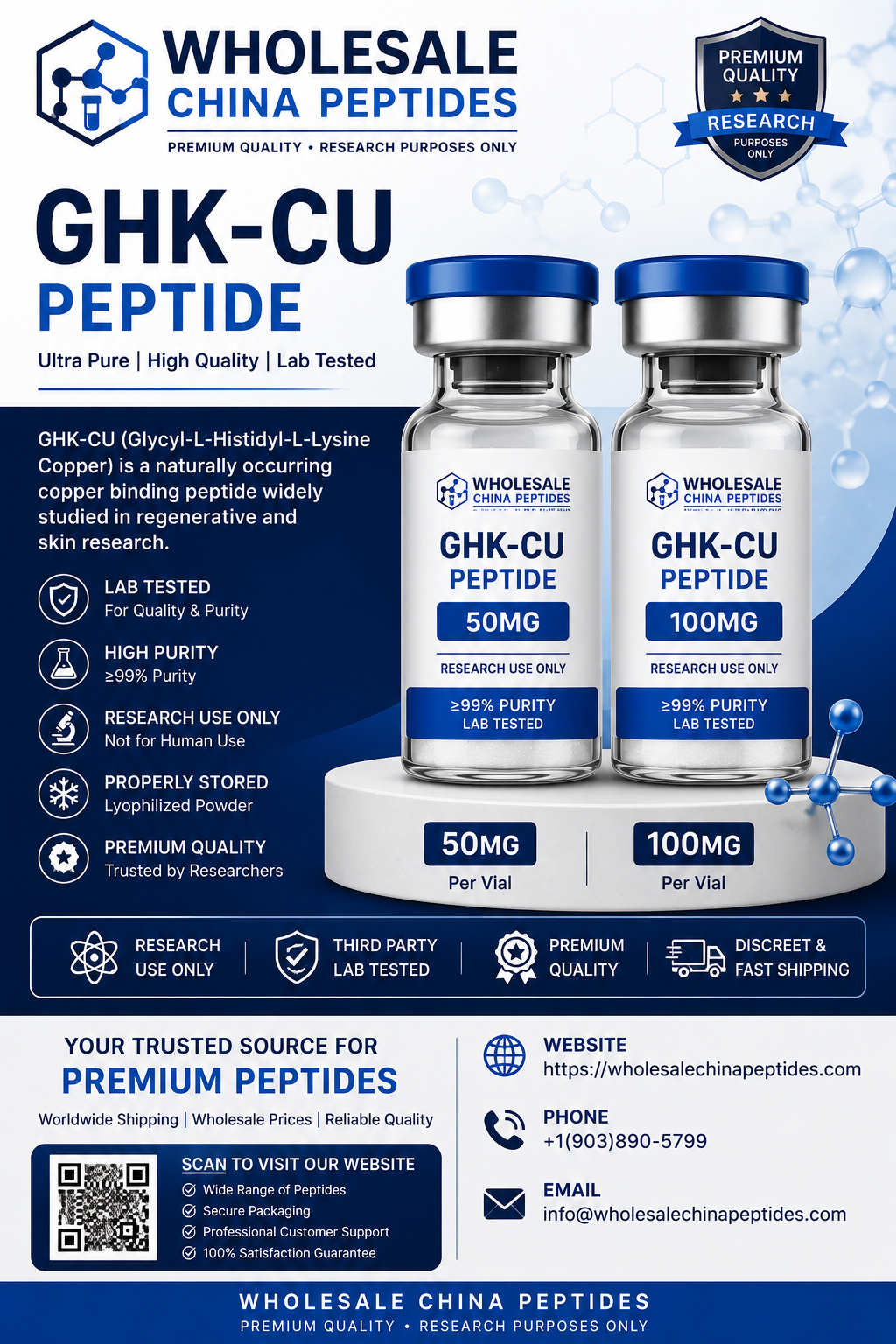
GHK-Cu Peptide
Price range: $65.00 through $90.00
GHK-Cu Peptide: Chemical Composition & Structure
Molecular Formula:
C₁₄H₂₂N₆O₄Cu
Molecular Weight:
403.9 g/mol
Amino Acid Sequence:
Glycyl-L-Histidyl-L-Lysine (GHK) + Copper (Cu²⁺)
Key Structural Features:
- Copper ion (Cu²⁺) binding – Enhances stability and biological activity.
- Small peptide size (3 amino acids) – Allows for rapid absorption and tissue penetration.
- High affinity for copper – Forms a stable complex that resists degradation.
Chemical Properties:
| Property | Details |
|---|---|
| Solubility | Water-soluble (reconstitute with bacteriostatic water) |
| Storage (Lyophilized) | -20°C (stable for 2+ years) |
| Storage (Reconstituted) | 2-8°C (stable for 7-14 days) |
| Half-Life | ~1-2 hours (varies by administration route) |
| Purity | ≥98% (HPLC-verified) |
Where to Buy High-Quality GHK-Cu for Research
For researchers seeking pharmaceutical-grade GHK-Cu peptide, Wholesale China Peptides offers:
✅ ≥98% Purity (HPLC-verified)
✅ Lyophilized for long-term stability
✅ Batch-specific COAs (Certificate of Analysis)
✅ Bulk & wholesale pricing for institutions
✅ Secure, discreet shipping worldwide
Note: GHK-Cu is for research use only—not for human consumption, medical treatment, or performance enhancement.
GHK-Cu Peptide: A Comprehensive Research Guide
Introduction to GHK-Cu Peptide
GHK-Cu (Glycyl-L-Histidyl-L-Lysine-Copper) is a naturally occurring copper peptide that plays a crucial role in tissue regeneration, wound healing, and anti-aging processes. First discovered in human plasma, GHK-Cu has since been extensively studied for its potent regenerative, anti-inflammatory, and antioxidant properties.
At Wholesale China Peptides, researchers can access high-purity GHK-Cu peptide for controlled laboratory studies. This 1000+ word guide covers everything scientists need to know about GHK-Cu, including its chemical composition, mechanisms of action, research benefits, dosage protocols, and safety considerations.
What Is GHK-Cu Peptide?
GHK-Cu is a tripeptide (Gly-His-Lys) bound to a copper ion (Cu²⁺), forming a stable complex that enhances its biological activity. It is naturally present in human plasma, saliva, and urine, with levels declining with age.
Key Features of GHK-Cu:
✅ Potent tissue regenerator – Accelerates wound healing and skin repair.
✅ Anti-aging effects – Stimulates collagen, elastin, and glycosaminoglycan production.
✅ Anti-inflammatory properties – Reduces oxidative stress and inflammation.
✅ Neuroprotective effects – Studied in Alzheimer’s and Parkinson’s models.
✅ Hair growth stimulator – Promotes follicle regeneration and hair thickness.
GHK-Cu Peptide: Chemical Composition & Structure
Molecular Formula:
C₁₄H₂₂N₆O₄Cu
Molecular Weight:
403.9 g/mol
Amino Acid Sequence:
Glycyl-L-Histidyl-L-Lysine (GHK) + Copper (Cu²⁺)
Key Structural Features:
- Copper ion (Cu²⁺) binding – Enhances stability and biological activity.
- Small peptide size (3 amino acids) – Allows for rapid absorption and tissue penetration.
- High affinity for copper – Forms a stable complex that resists degradation.
Chemical Properties:
| Property | Details |
|---|---|
| Solubility | Water-soluble (reconstitute with bacteriostatic water) |
| Storage (Lyophilized) | -20°C (stable for 2+ years) |
| Storage (Reconstituted) | 2-8°C (stable for 7-14 days) |
| Half-Life | ~1-2 hours (varies by administration route) |
| Purity | ≥98% (HPLC-verified) |
How GHK-Cu Works: Mechanisms of Action
GHK-Cu exerts its effects through multiple biological pathways, making it a versatile peptide for regenerative medicine, anti-aging, and tissue repair research.
1. Tissue Regeneration & Wound Healing
- Stimulates collagen and elastin production – Enhances skin firmness and elasticity.
- Accelerates wound closure – Promotes fibroblast proliferation and migration.
- Reduces scar formation – Improves tissue remodeling and regeneration.
2. Anti-Aging & Skin Rejuvenation
- Boosts glycosaminoglycan (GAG) synthesis – Improves skin hydration and plumpness.
- Activates stem cells – Supports skin renewal and repair.
- Reduces oxidative stress – Protects against UV-induced skin damage.
3. Anti-Inflammatory & Antioxidant Effects
- Inhibits pro-inflammatory cytokines (e.g., TNF-α, IL-6).
- Scavenges free radicals – Reduces oxidative damage.
- Modulates immune response – Promotes tissue repair without excessive inflammation.
4. Neuroprotection & Cognitive Function
- Protects neurons from oxidative stress – Studied in Alzheimer’s and Parkinson’s models.
- Enhances synaptic plasticity – May improve memory and learning.
- Reduces neuroinflammation – Supports brain health and cognitive function.
5. Hair Growth & Follicle Regeneration
- Stimulates hair follicle stem cells – Promotes hair growth and thickness.
- Prolongs the anagen (growth) phase – Reduces hair loss and thinning.
- Improves scalp blood circulation – Enhances nutrient delivery to hair follicles.
GHK-Cu Peptide Benefits in Research
GHK-Cu is studied for its potential therapeutic applications, including:
1. Skin Regeneration & Anti-Aging
- Reduces wrinkles and fine lines – Stimulates collagen and elastin production.
- Improves skin elasticity and firmness – Enhances youthful appearance.
- Accelerates wound healing – Promotes faster recovery from injuries and surgeries.
- Reduces hyperpigmentation – Evens out skin tone and texture.
2. Wound Healing & Tissue Repair
- Enhances wound closure – Accelerates tissue regeneration.
- Reduces scar formation – Improves cosmetic outcomes.
- Promotes angiogenesis – Enhances blood vessel formation for better healing.
3. Neuroprotection & Cognitive Function
- Protects against neurodegenerative diseases – Studied in Alzheimer’s and Parkinson’s models.
- Improves memory and learning – Enhances synaptic plasticity.
- Reduces neuroinflammation – Supports brain health and cognitive function.
4. Hair Growth & Follicle Regeneration
- Stimulates hair growth – Promotes thicker, fuller hair.
- Reduces hair loss – Prolongs the anagen (growth) phase.
- Improves scalp health – Enhances blood circulation and nutrient delivery.
5. Anti-Inflammatory & Antioxidant Effects
- Reduces inflammation – Modulates cytokine production.
- Scavenges free radicals – Protects against oxidative stress.
- Supports immune function – Promotes tissue repair and regeneration.
GHK-Cu Dosage Protocols for Research
Since GHK-Cu is not approved for human use, dosage guidelines are based on preclinical and clinical research models. Researchers should adjust protocols based on study objectives.
General Dosage Guidelines
| Study Type | Dosage Range | Administration Route | Frequency |
|---|---|---|---|
| Skin Regeneration | 0.1–1 mg/mL | Topical (cream/serum) | Daily for 4–12 weeks |
| Wound Healing | 0.5–2 mg/mL | Topical or Subcutaneous (SC) | Daily for 2–8 weeks |
| Anti-Aging | 0.1–1 mg/mL | Topical or SC | Daily for 8–12 weeks |
| Neuroprotection | 1–10 mg/kg | Intraperitoneal (IP) or SC | Daily for 4–8 weeks |
| Hair Growth | 0.5–2 mg/mL | Topical (scalp application) | Daily for 8–12 weeks |
Key Dosage Considerations
✔ Start with low concentrations (0.1–0.5 mg/mL) for topical applications.
✔ Monitor skin response (to avoid irritation).
✔ Use frequent dosing (due to short half-life).
✔ Consider combination therapies (e.g., with vitamin C or hyaluronic acid for enhanced effects).
Potential Side Effects & Safety Considerations
While GHK-Cu is generally well-tolerated in research, potential side effects should be monitored:
Common Side Effects (Observed in Animal Models)
| Side Effect | Cause | Mitigation Strategy |
|---|---|---|
| Mild skin irritation | Topical application | Reduce concentration or frequency |
| Redness or itching | Allergic reaction | Conduct patch test before full application |
| Transient nausea (high doses) | Systemic administration | Reduce dose or switch to topical use |
Long-Term Considerations
⚠ Copper toxicity (rare) – High doses may lead to copper accumulation.
⚠ Hormonal effects – May interact with thyroid and adrenal function (monitor in long-term studies).
⚠ Drug interactions – May enhance effects of anti-inflammatory or antioxidant drugs.
Where to Buy High-Quality GHK-Cu for Research
For researchers seeking pharmaceutical-grade GHK-Cu peptide, Wholesale China Peptides offers:
✅ ≥98% Purity (HPLC-verified)
✅ Lyophilized for long-term stability
✅ Batch-specific COAs (Certificate of Analysis)
✅ Bulk & wholesale pricing for institutions
✅ Secure, discreet shipping worldwide
Note: GHK-Cu is for research use only—not for human consumption, medical treatment, or performance enhancement.
Conclusion: Why GHK-Cu is a Breakthrough in Regenerative Medicine
GHK-Cu is one of the most potent and versatile peptides for skin regeneration, wound healing, and anti-aging research. Its ability to stimulate collagen, elastin, and glycosaminoglycan production makes it a valuable tool for studying:
✔ Skin rejuvenation and anti-aging
✔ Wound healing and tissue repair
✔ Neuroprotection and cognitive function
✔ Hair growth and follicle regeneration
✔ Anti-inflammatory and antioxidant effects
For high-purity GHK-Cu peptide at competitive prices, visit Wholesale China Peptides.
Disclaimer: This article is for educational and research purposes only. GHK-Cu is not approved for human use and should only be used in IRB-approved laboratory settings.
Ready to Buy GHK-Cu for Research?
🔹 Visit Wholesale China Peptides
🔹 Request a COA before purchasing
🔹 Consult with a research advisor for proper dosing protocols
| Choose An Option | 50mg*10vials, 100mg*10vials |
|---|
Be the first to review “GHK-Cu Peptide”
Related products
Anti-Aging & Longevity Research Peptides
Healing & Recovery Peptides

Growth Hormone Secretagogues

Healing & Recovery Peptides

Growth Hormone Secretagogues

Healing & Recovery Peptides
Muscle & Performance Research Peptides

Cognitive & Neurological Research Peptides
Reviews
There are no reviews yet.