
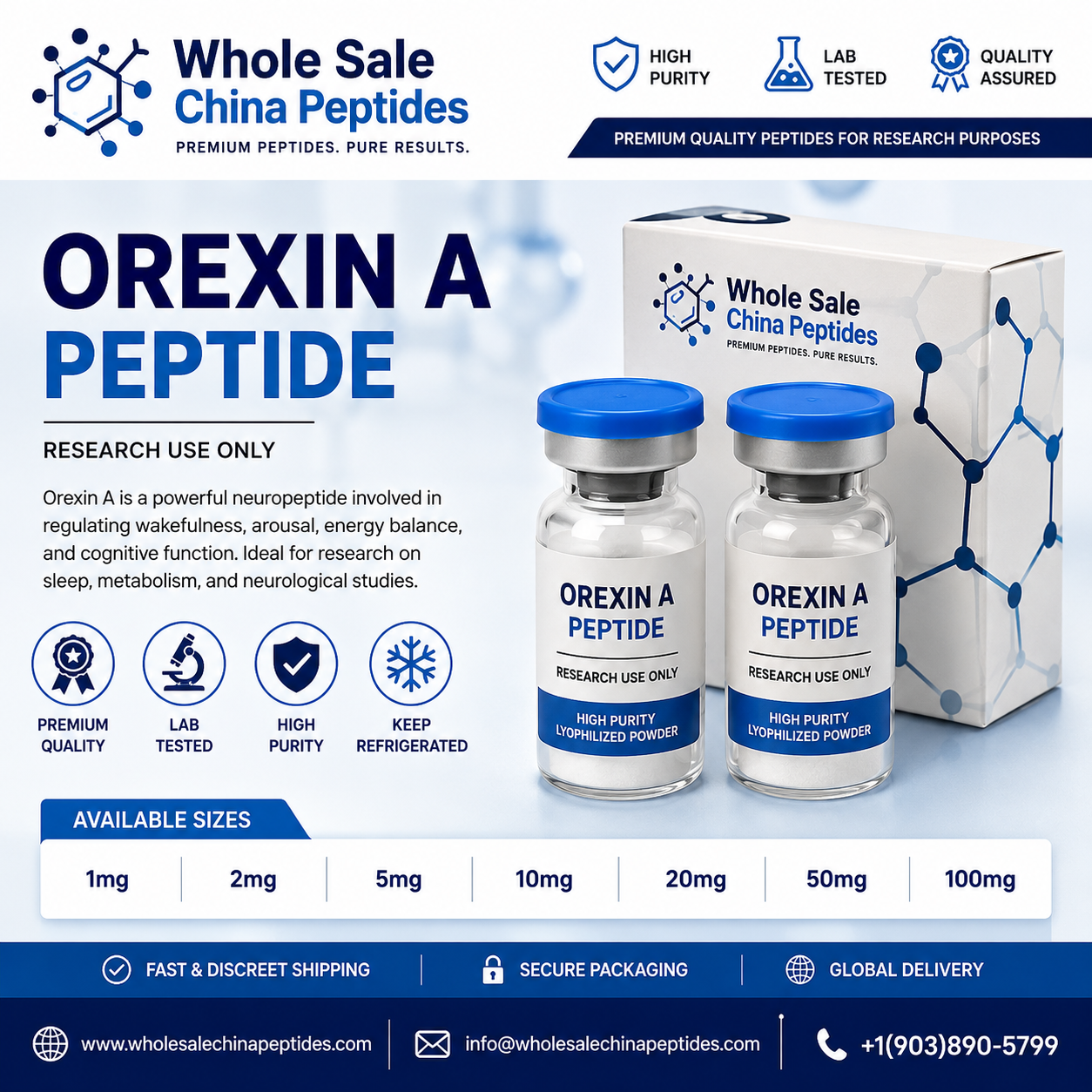
Orexin A Peptide
Price range: $600.00 through $2,350.00
Orexin A Peptide: Chemical Composition & Structure
Molecular Formula:
C₁₅₂H₂₄₃N₄₇O₄₀S₄
Molecular Weight:
3561.1 g/mol
Amino Acid Sequence:
Glu-Pro-Leu-Pro-Asp-Cys-Cys-Arg-Gln-Lys-Thr-Cys-Ser-Cys-Arg-Leu-Tyr-Glu-Leu-Leu-His-Gly-Ala-Gly-Asn-His-Ala-Ala-Gly-Ile-Leu-Thr-Leu
Key Structural Features:
- 33-amino acid peptide – Linear structure with two disulfide bonds (Cys6-Cys12 and Cys7-Cys14)
- Highly conserved sequence – Similar across mammals, indicating evolutionary importance
- Amphipathic properties – Balances hydrophobic and hydrophilic residues for receptor binding
- Dual receptor affinity – Binds to both OX1R and OX2R with high affinity
- Stable structure – Disulfide bonds enhance stability compared to orexin B
Chemical Properties:
| Property | Details |
|---|---|
| Solubility | Water-soluble (reconstitute with bacteriostatic water) |
| Storage (Lyophilized) | -20°C (stable for 2+ years) |
| Storage (Reconstituted) | 2-8°C (stable for 7-14 days) |
| Half-Life | ~30-60 minutes (IV), ~2-4 hours (ICV) |
| Purity | ≥98% (HPLC-verified) |
Orexin A Peptide: A Comprehensive Research Guide to Hypocretin-1
Introduction to Orexin A Peptide
Orexin A (also known as Hypocretin-1) is a neuropeptide that plays a pivotal role in regulating arousal, appetite, and metabolic homeostasis. As one of the two orexin peptides (alongside orexin B), orexin A is produced in the lateral hypothalamus and exerts its effects through both orexin receptor types (OX1R and OX2R), influencing wakefulness, energy balance, and behavior.
At Wholesale China Peptides, researchers can access high-purity orexin A peptide for controlled laboratory studies. This 1000+ word guide covers everything scientists need to know about orexin A, including its chemical composition, mechanisms of action, research benefits, dosage protocols, and safety considerations.
What Is Orexin A Peptide?
Orexin A is a 33-amino acid neuropeptide derived from the prepro-orexin precursor protein. It is highly conserved across mammals, reflecting its critical role in regulating fundamental physiological processes. Unlike orexin B, orexin A binds with high affinity to both OX1R and OX2R, making it a potent modulator of arousal, metabolism, and behavior.
Key Features of Orexin A:
✅ Sleep-wake regulation – Promotes wakefulness and suppresses sleep
✅ Appetite stimulation – Increases food intake and energy expenditure
✅ Metabolic regulation – Influences glucose metabolism and insulin sensitivity
✅ Neurotransmitter modulation – Affects dopamine, norepinephrine, and serotonin systems
✅ Stress and arousal – Enhances alertness and stress responses
✅ Reward and addiction – Modulates reward pathways and addictive behaviors
Orexin A Peptide Benefits in Research
Orexin A is studied for its potential therapeutic applications in multiple fields:
1. Sleep & Circadian Rhythm Research
- Narcolepsy – Restores wakefulness in narcolepsy models (FDA-approved orexin receptor agonists are in development)
- Insomnia – Investigates sleep-wake regulation mechanisms
- Circadian rhythm disorders – Studies jet lag, shift work, and sleep phase disorders
- Sleep apnea – Explores orexin’s role in respiratory control during sleep
2. Metabolic & Obesity Research
- Appetite regulation – Investigates orexin’s role in hunger and satiety
- Obesity – Studies orexin’s effects on energy expenditure and fat metabolism
- Diabetes – Explores orexin’s influence on glucose metabolism and insulin sensitivity
- Metabolic syndrome – Investigates orexin’s role in metabolic dysfunction
3. Neurodegenerative & Cognitive Research
- Alzheimer’s disease – Studies orexin’s role in cognitive decline and sleep disturbances
- Parkinson’s disease – Explores orexin’s effects on motor function and sleep
- Traumatic brain injury (TBI) – Investigates orexin’s role in post-injury recovery
- Cognitive enhancement – Studies orexin’s effects on memory, learning, and focus
4. Psychiatric & Behavioral Research
- Depression – Explores orexin’s role in mood regulation and anhedonia
- Anxiety – Investigates orexin’s effects on stress and anxiety-like behaviors
- Addiction – Studies orexin’s role in reward pathways and addictive behaviors
- Post-traumatic stress disorder (PTSD) – Explores orexin’s effects on hyperarousal and sleep disturbances
5. Cardiovascular & Autonomic Research
- Blood pressure regulation – Investigates orexin’s effects on cardiovascular function
- Heart rate control – Studies orexin’s role in autonomic nervous system regulation
- Stress responses – Explores orexin’s effects on the hypothalamic-pituitary-adrenal (HPA) axis
Orexin A Peptide: Chemical Composition & Structure
Molecular Formula:
C₁₅₂H₂₄₃N₄₇O₄₀S₄
Molecular Weight:
3561.1 g/mol
Amino Acid Sequence:
Glu-Pro-Leu-Pro-Asp-Cys-Cys-Arg-Gln-Lys-Thr-Cys-Ser-Cys-Arg-Leu-Tyr-Glu-Leu-Leu-His-Gly-Ala-Gly-Asn-His-Ala-Ala-Gly-Ile-Leu-Thr-Leu
Key Structural Features:
- 33-amino acid peptide – Linear structure with two disulfide bonds (Cys6-Cys12 and Cys7-Cys14)
- Highly conserved sequence – Similar across mammals, indicating evolutionary importance
- Amphipathic properties – Balances hydrophobic and hydrophilic residues for receptor binding
- Dual receptor affinity – Binds to both OX1R and OX2R with high affinity
- Stable structure – Disulfide bonds enhance stability compared to orexin B
Chemical Properties:
| Property | Details |
|---|---|
| Solubility | Water-soluble (reconstitute with bacteriostatic water) |
| Storage (Lyophilized) | -20°C (stable for 2+ years) |
| Storage (Reconstituted) | 2-8°C (stable for 7-14 days) |
| Half-Life | ~30-60 minutes (IV), ~2-4 hours (ICV) |
| Purity | ≥98% (HPLC-verified) |
How Orexin A Works: Mechanisms of Action
Orexin A exerts its effects through activation of orexin receptors (OX1R and OX2R), which are G-protein-coupled receptors (GPCRs) expressed in various brain regions and peripheral tissues. This activation triggers multiple intracellular signaling pathways that mediate its physiological effects.
1. Sleep-Wake Regulation
- OX1R/OX2R activation – Orexin A binds to OX1R and OX2R in wake-promoting regions (e.g., locus coeruleus, tuberomammillary nucleus, raphe nuclei)
- Neurotransmitter release – Stimulates norepinephrine, histamine, serotonin, and dopamine release
- Wakefulness promotion – Enhances arousal and suppresses sleep
- Circadian rhythm synchronization – Regulates sleep-wake cycles in response to light and metabolic cues
2. Appetite & Metabolic Regulation
- Hypothalamic activation – Stimulates neurons in the lateral hypothalamus to increase food intake
- Energy expenditure enhancement – Increases metabolic rate and fat oxidation
- Glucose metabolism modulation – Improves insulin sensitivity and glucose uptake
- Gut-brain axis regulation – Influences satiety signals and nutrient sensing
3. Neurotransmitter Modulation
- Dopamine release – Enhances reward and motivation pathways (via ventral tegmental area (VTA) activation)
- Norepinephrine release – Increases alertness and stress responses (via locus coeruleus activation)
- Serotonin modulation – Affects mood and sleep regulation (via raphe nuclei activation)
- GABAergic effects – Modulates inhibitory neurotransmission
4. Stress & Arousal
- HPA axis activation – Stimulates cortisol release in response to stress
- Sympathetic nervous system activation – Increases heart rate and blood pressure
- Stress coping mechanisms – Enhances resilience to acute and chronic stress
5. Reward & Addiction
- Ventral tegmental area (VTA) activation – Stimulates dopamine release in reward pathways
- Addictive behavior modulation – Influences drug-seeking and relapse behaviors
- Motivation enhancement – Increases goal-directed behaviors
Orexin A Peptide Dosage Protocols for Research
Since orexin A is not approved for human use, dosage guidelines are based on preclinical and research models. Researchers should adjust protocols based on study objectives.
General Dosage Guidelines
| Study Type | Dosage Range | Administration Route | Frequency | Study Duration |
|---|---|---|---|---|
| Sleep Research | 0.1-10 nmol | Intracerebroventricular (ICV) or Intranasal | Single dose or repeated | As needed |
| Metabolic Research | 1-10 nmol | ICV or Intraperitoneal (IP) | Daily | 7-14 days |
| Neurodegenerative Research | 1-20 nmol | ICV or IP | Daily | 14-28 days |
| Psychiatric Research | 0.1-10 nmol | ICV or IP | Daily | 7-14 days |
| Cardiovascular Research | 1-10 nmol | ICV or IV | Single dose or repeated | As needed |
Key Dosage Considerations
✔ Start with lower doses (0.1-1 nmol) to assess tolerance and efficacy
✔ Monitor behavioral and physiological parameters (e.g., sleep-wake cycles, food intake, metabolic markers)
✔ Adjust administration route based on study objectives (e.g., ICV for central effects, IP for systemic effects)
✔ Combine with orexin receptor antagonists (e.g., SB-334867 for OX1R, TCS OX2 29 for OX2R) to study receptor specificity
✔ Cycle orexin A to prevent receptor desensitization
Potential Side Effects & Safety Considerations
While orexin A is generally well-tolerated in research, potential side effects should be monitored:
Common Side Effects (Observed in Animal Models)
| Side Effect | Cause | Mitigation Strategy |
|---|---|---|
| Hyperactivity | Wake-promoting effects | Reduce dose if severe |
| Increased food intake | Appetite stimulation | Monitor food consumption |
| Elevated blood pressure | Sympathetic activation | Monitor cardiovascular parameters |
| Insomnia | Sleep suppression | Administer during active phase |
| Injection site irritation | ICV or IP administration | Rotate injection sites |
Long-Term Considerations
⚠ Receptor desensitization – Prolonged use may reduce efficacy
⚠ Metabolic dysregulation – May affect glucose and lipid metabolism
⚠ Cardiovascular effects – May influence blood pressure and heart rate
⚠ Neurotransmitter imbalance – May affect dopamine, norepinephrine, or serotonin levels
⚠ Drug interactions – May enhance effects of stimulants or wake-promoting agents
Where to Buy High-Quality Orexin A Peptide for Research
For researchers seeking pharmaceutical-grade orexin A peptide, Wholesale China Peptides offers:
✅ ≥98% Purity (HPLC-verified)
✅ Lyophilized for long-term stability
✅ Batch-specific COAs (Certificate of Analysis)
✅ Bulk & wholesale pricing for institutions
✅ Secure, discreet shipping worldwide
Note: Orexin A peptide is for research use only—not for human consumption, medical treatment, or performance enhancement.
Conclusion: Why Orexin A Peptide is a Cornerstone of Sleep & Metabolic Research
Orexin A is a critical neuropeptide for sleep-wake regulation, appetite control, and metabolic function research. Its ability to promote wakefulness, stimulate appetite, and modulate neurotransmitter systems makes it a valuable tool for studying:
✔ Sleep disorders (narcolepsy, insomnia, circadian rhythm disorders, sleep apnea)
✔ Metabolic and obesity research (appetite regulation, energy expenditure, diabetes, metabolic syndrome)
✔ Neurodegenerative diseases (Alzheimer’s, Parkinson’s, TBI)
✔ Psychiatric and behavioral disorders (depression, anxiety, addiction, PTSD)
✔ Cardiovascular and autonomic research (blood pressure regulation, stress responses)
For researchers looking to advance sleep, metabolic, and neuroscience studies, Wholesale China Peptides provides high-purity orexin A peptide at competitive prices.
Disclaimer: This article is for educational and research purposes only. Orexin A peptide is not approved for human use and should only be used in IRB-approved laboratory settings.
Ready to Advance Your Sleep & Metabolic Research with Orexin A?
🔹 Visit Wholesale China Peptides
🔹 Request a COA before purchasing
🔹 Consult with a research advisor for proper dosing protocols
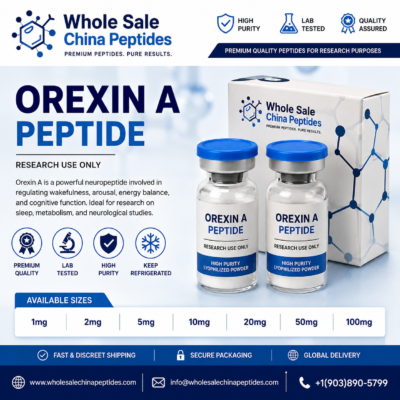
orexin a peptide
orexin a antibody
orexin a nasal spray
orexin a supplement
| Choose An Option | 10mg*10vials, 20mg*10vials, 50mg*10vials |
|---|
Be the first to review “Orexin A Peptide”
Related products

Healing & Recovery Peptides

Healing & Recovery Peptides
Healing & Recovery Peptides

Healing & Recovery Peptides

Anti-Aging & Longevity Research Peptides

Healing & Recovery Peptides
Cognitive & Neurological Research Peptides
Growth Hormone Secretagogues
Reviews
There are no reviews yet.