
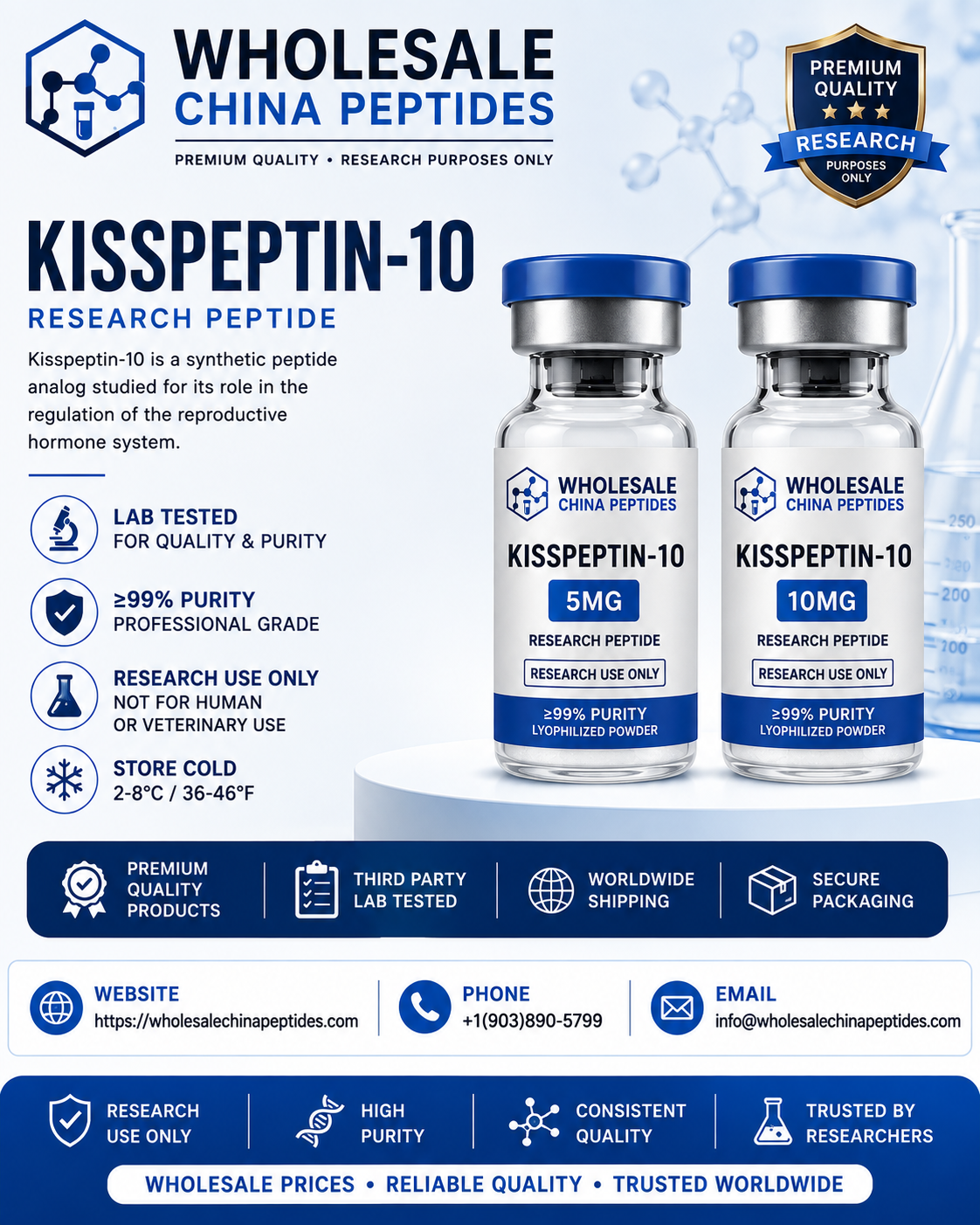
Kisspeptin-10 Peptide
Price range: $65.00 through $99.00
Kisspeptin-10 Dosage Protocols for Research
Since kisspeptin-10 is not approved for human use, dosage guidelines are based on preclinical and clinical research models. Researchers should adjust protocols based on study objectives.
General Dosage Guidelines
| Study Type | Dosage Range | Administration Route | Frequency |
|---|---|---|---|
| Reproductive Stimulation | 0.3–3 nmol/kg | Intravenous (IV) or Subcutaneous (SC) | Single dose or repeated (every 1–2 hours) |
| Fertility Research | 1–10 nmol/kg | SC or IV | Daily for 3–7 days |
| Metabolic Studies | 0.5–5 nmol/kg | SC or IP (intraperitoneal) | Daily for 7–14 days |
| Neuroprotection Research | 1–10 nmol/kg | ICV (intracerebroventricular) or SC | Daily for 5–10 days |
| Cancer Metastasis Models | 3–30 nmol/kg | IV or SC | Daily for 14–28 days |
Key Dosage Considerations
✔ Start with low doses (0.3–1 nmol/kg) to assess hormonal response.
✔ Monitor LH & FSH levels (to avoid overstimulation).
✔ Use frequent dosing (due to short half-life).
✔ Consider combination therapies (e.g., with GnRH analogs for fertility research).
Where to Buy High-Quality Kisspeptin-10 for Research
For researchers seeking pharmaceutical-grade kisspeptin-10, Wholesale China Peptides offers:
✅ ≥98% Purity (HPLC-verified)
✅ Lyophilized for long-term stability
✅ Batch-specific COAs (Certificate of Analysis)
✅ Bulk & wholesale pricing for institutions
✅ Secure, discreet shipping worldwide
Note: Kisspeptin-10 is for research use only—not for human consumption, medical treatment, or performance enhancement.
Kisspeptin-10 Peptide: A Comprehensive Research Guide
Introduction to Kisspeptin-10 Peptide
Kisspeptin-10 is a decapeptide (10 amino acids) derived from the Kiss1 gene, playing a pivotal role in reproductive hormone regulation, puberty onset, and metabolic signaling. As a key regulator of the hypothalamic-pituitary-gonadal (HPG) axis, kisspeptin-10 has become a critical tool in endocrinology, fertility research, and neuropharmacology.
At Wholesale China Peptides, researchers can access high-purity kisspeptin-10 for controlled laboratory studies. This 1000+ word guide covers everything scientists need to know about kisspeptin-10, including its chemical composition, mechanisms of action, research benefits, dosage protocols, and safety considerations.
What Is Kisspeptin-10 Peptide?
Kisspeptin-10 is the shortest biologically active fragment of the kisspeptin protein, consisting of 10 amino acids (YNWNSFGLRF-NH₂). It binds with high affinity to the G-protein-coupled receptor GPR54 (Kiss1R), triggering a cascade of hormonal signals that regulate gonadotropin-releasing hormone (GnRH) release.
Key Features of Kisspeptin-10:
✅ Potent GnRH stimulator – Directly activates GnRH neurons in the hypothalamus.
✅ Regulates puberty & fertility – Essential for reproductive axis activation.
✅ Metabolic & appetite effects – Influences energy balance and glucose metabolism.
✅ Neuroprotective properties – Studied in neurodegenerative disease models.
✅ Short half-life – Requires frequent dosing for sustained effects.
Kisspeptin-10 Peptide: Chemical Composition & Structure
Molecular Formula:
C₆₃H₈₃N₁₇O₁₄
Molecular Weight:
1302.49 g/mol
Amino Acid Sequence:
Tyr-Asn-Trp-Asn-Ser-Phe-Gly-Leu-Arg-Phe-NH₂ (YNWNSFGLRF-NH₂)
Key Structural Modifications:
- Amidated C-terminus (Phe-NH₂) – Enhances receptor binding affinity.
- Hydrophobic residues (Trp, Phe, Leu) – Critical for GPR54 activation.
- Short peptide length (10 AA) – Allows for rapid absorption and action.
Chemical Properties:
| Property | Details |
|---|---|
| Solubility | Water-soluble (reconstitute with bacteriostatic water) |
| Storage (Lyophilized) | -20°C (stable for 2+ years) |
| Storage (Reconstituted) | 2-8°C (stable for 7-14 days) |
| Half-Life | ~30 minutes (IV), ~2 hours (SC) |
| Purity | ≥98% (HPLC-verified) |
How Kisspeptin-10 Works: Mechanisms of Action
Kisspeptin-10 exerts its effects by binding to the GPR54 (Kiss1R) receptor, primarily located on GnRH neurons in the hypothalamus. This triggers a hormonal cascade that regulates reproduction, metabolism, and neuroendocrine function.
Step-by-Step Mechanism:
- Binding to GPR54 (Kiss1R) – Kisspeptin-10 binds to GPR54 receptors on GnRH neurons.
- Activation of Phospholipase C (PLC) – Triggers intracellular calcium release.
- GnRH Release – Stimulates pulsatile GnRH secretion from the hypothalamus.
- LH & FSH Secretion – GnRH signals the pituitary gland to release luteinizing hormone (LH) and follicle-stimulating hormone (FSH).
- Gonadal Activation – LH and FSH stimulate testosterone, estrogen, and progesterone production in the gonads.
Why Kisspeptin-10 is Unique Among Reproductive Peptides
- Directly stimulates GnRH neurons (unlike indirect modulators).
- More potent than full-length kisspeptin (10x stronger in some studies).
- Minimal off-target effects (highly selective for GPR54).
- Regulates both reproductive and metabolic pathways.
Kisspeptin-10 Peptide Benefits in Research
Kisspeptin-10 is studied for its potential therapeutic applications, including:
1. Reproductive Health & Fertility Research
- Induces puberty onset (studies in hypogonadotropic hypogonadism).
- Enhances ovulation & sperm production (potential for infertility treatments).
- Regulates menstrual cycles (studies in polycystic ovary syndrome (PCOS)).
- May improve assisted reproduction outcomes (IVF and IUI models).
2. Metabolic & Appetite Regulation
- Increases insulin sensitivity (studies in diabetes and obesity models).
- Reduces food intake (potential for weight management research).
- Modulates glucose metabolism (studies in metabolic syndrome).
3. Neuroendocrine & Neuroprotective Effects
- Protects against neurodegeneration (studies in Alzheimer’s and Parkinson’s models).
- Enhances cognitive function (potential for dementia research).
- Regulates stress responses (studies in anxiety and depression models).
4. Cancer Research & Tumor Suppression
- Inhibits tumor metastasis (originally discovered as a metastasis suppressor gene).
- May reduce angiogenesis (studies in breast and prostate cancer models).
Kisspeptin-10 Dosage Protocols for Research
Since kisspeptin-10 is not approved for human use, dosage guidelines are based on preclinical and clinical research models. Researchers should adjust protocols based on study objectives.
General Dosage Guidelines
| Study Type | Dosage Range | Administration Route | Frequency |
|---|---|---|---|
| Reproductive Stimulation | 0.3–3 nmol/kg | Intravenous (IV) or Subcutaneous (SC) | Single dose or repeated (every 1–2 hours) |
| Fertility Research | 1–10 nmol/kg | SC or IV | Daily for 3–7 days |
| Metabolic Studies | 0.5–5 nmol/kg | SC or IP (intraperitoneal) | Daily for 7–14 days |
| Neuroprotection Research | 1–10 nmol/kg | ICV (intracerebroventricular) or SC | Daily for 5–10 days |
| Cancer Metastasis Models | 3–30 nmol/kg | IV or SC | Daily for 14–28 days |
Key Dosage Considerations
✔ Start with low doses (0.3–1 nmol/kg) to assess hormonal response.
✔ Monitor LH & FSH levels (to avoid overstimulation).
✔ Use frequent dosing (due to short half-life).
✔ Consider combination therapies (e.g., with GnRH analogs for fertility research).
Potential Side Effects & Safety Considerations
While kisspeptin-10 is generally well-tolerated in research, potential side effects should be monitored:
Common Side Effects (Observed in Animal Models)
| Side Effect | Cause | Mitigation Strategy |
|---|---|---|
| Flushing & warmth | Vasodilation from GnRH release | Reduce dose if severe |
| Nausea (mild) | Central nervous system effects | Administer with food (if oral) |
| Headaches | Hormonal fluctuations | Monitor hydration & electrolytes |
| Injection site irritation | Subcutaneous administration | Rotate injection sites |
Long-Term Considerations
⚠ Hormonal overstimulation – Prolonged use may lead to desensitization of GnRH receptors.
⚠ Reproductive axis suppression – High doses may downregulate LH/FSH over time.
⚠ Metabolic effects – May alter glucose and insulin sensitivity (monitor in diabetic models).
Where to Buy High-Quality Kisspeptin-10 for Research
For researchers seeking pharmaceutical-grade kisspeptin-10, Wholesale China Peptides offers:
✅ ≥98% Purity (HPLC-verified)
✅ Lyophilized for long-term stability
✅ Batch-specific COAs (Certificate of Analysis)
✅ Bulk & wholesale pricing for institutions
✅ Secure, discreet shipping worldwide
Note: Kisspeptin-10 is for research use only—not for human consumption, medical treatment, or performance enhancement.
Conclusion: Why Kisspeptin-10 is a Breakthrough in Reproductive & Metabolic Research
Kisspeptin-10 is one of the most potent and selective peptides for reproductive, metabolic, and neuroendocrine research. Its ability to directly stimulate GnRH neurons makes it a valuable tool for studying:
✔ Fertility and puberty regulation
✔ Metabolic disorders (diabetes, obesity)
✔ Neurodegenerative diseases (Alzheimer’s, Parkinson’s)
✔ Cancer metastasis suppression
For high-purity kisspeptin-10 at competitive prices, visit Wholesale China Peptides.
Disclaimer: This article is for educational and research purposes only. Kisspeptin-10 is not approved for human use and should only be used in IRB-approved laboratory settings.
Ready to Buy Kisspeptin-10 for Research?
🔹 Visit Wholesale China Peptides
🔹 Request a COA before purchasing
🔹 Consult with a research advisor for proper dosing protocols
| Choose An Option | 5mg*10vials, 10mg*10vials |
|---|
Be the first to review “Kisspeptin-10 Peptide”
Related products

Cognitive & Neurological Research Peptides
Healing & Recovery Peptides
Growth Hormone Secretagogues

Growth Hormone Secretagogues

Cognitive & Neurological Research Peptides

Growth Hormone Secretagogues

Healing & Recovery Peptides

Healing & Recovery Peptides
Reviews
There are no reviews yet.