
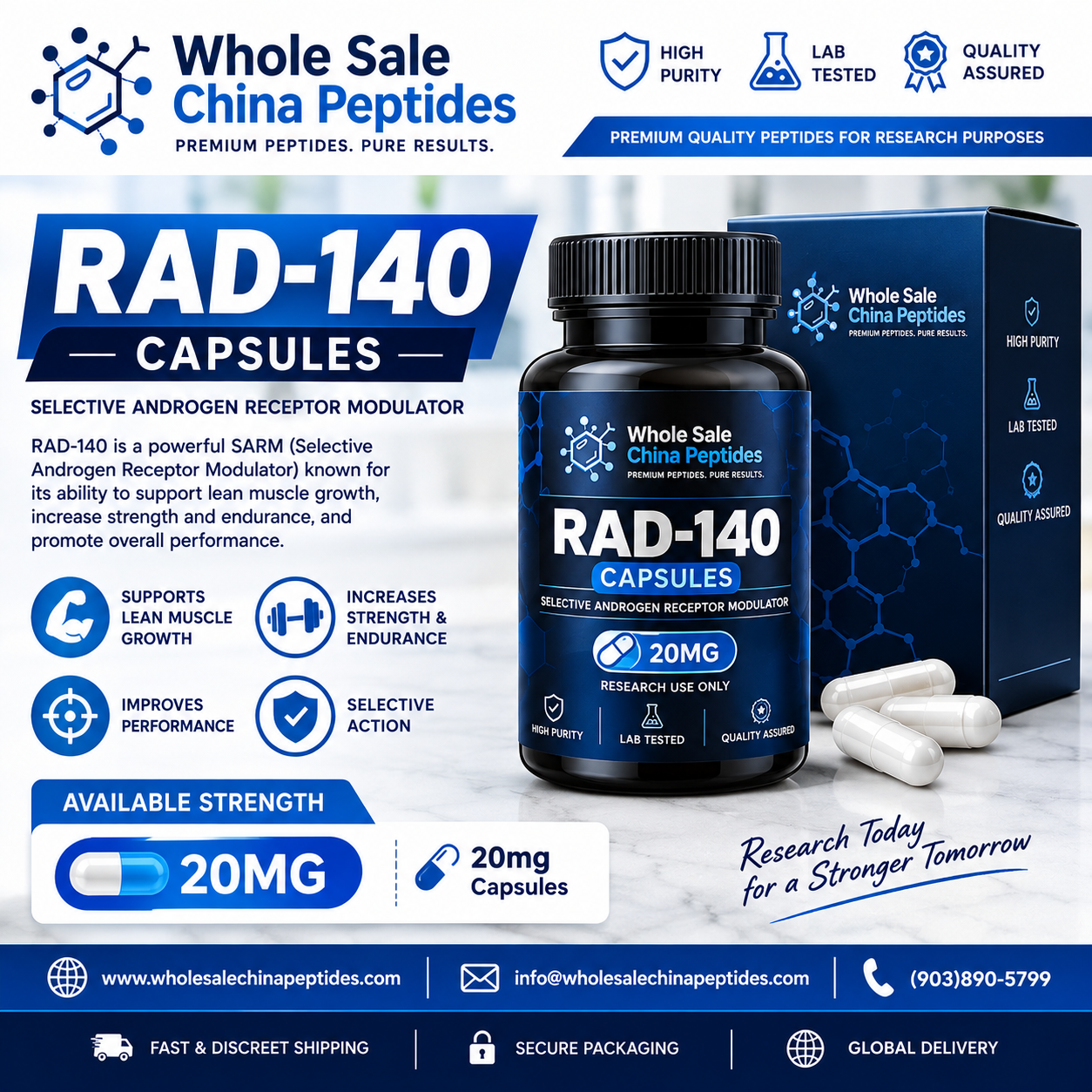
RAD-140 (Testolone)
$30.00
Chemical Information and Compositions of RAD-140
For researchers, biochemists, and wholesale distributors, the molecular structure of RAD-140 is a triumph of modern medicinal chemistry. Understanding its composition is vital for analytical testing, formulation, and predicting its biological behavior.
Official Chemical Nomenclature
- IUPAC Name: 2-chloro-4-[[(1R,2S)-1-hydroxy-2-methyl-1-propan-2-ylcyclopropyl]carbamoyl]-2-methyl-N-[4-cyano-3-(trifluoromethyl)phenyl]benzamide
- Chemical Formula: C20H16ClF3N3O3 (Note: some older literature cites C20H16ClN5O2 based on a nitrile isomer, but the standard synthesized API formula is C20H16ClF3N3O3)
- Molecular Weight: 434.32 g/mol
- CAS Number: 1182367-47-0
Structural Composition Breakdown
RAD-140 is a non-steroidal ligand. Its structural architecture is precisely tailored to exploit the shape of the androgen receptor (AR) ligand-binding domain (LBD):
- The Trifluoromethylphenyl Moiety: The inclusion of a trifluoromethyl (-CF3) group on the distal phenyl ring is a classic optimization. The high electronegativity and lipophilicity of the fluorine atoms increase the molecule’s metabolic stability and membrane permeability, preventing rapid hepatic destruction.
- The Cyanophenyl Group: A nitrile (cyano) group attached to the phenyl ring is critical for hydrogen bonding with specific amino acid residues (like Asn705 and Gln711) in the AR, anchoring the molecule securely.
- The Chlorobenzamide Core: The chloro-substituted benzamide ring provides conformational rigidity. This rigidity ensures RAD-140 maintains a specific spatial orientation that perfectly matches the AR’s active site, driving its exceptionally high binding affinity.
- The Hydroxycyclopropyl Group: The chiral 1-hydroxy-2-methylcyclopropyl group is the defining structural signature of RAD-140. This bulky, three-dimensional group mimics the C/D ring system of natural steroids. It physically blocks co-activator proteins from binding to the AR in certain tissues (like the prostate), which is the fundamental mechanism of its tissue selectivity.
Physical and Chemical Properties
- State at Room Temperature: Solid (Crystalline Powder)
- Color: White to off-white
- Solubility: Practically insoluble in water; soluble in DMSO, PEG 400, ethanol, and methanol. Its poor aqueous solubility necessitates specific excipient matrices for oral capsule formulation.
- Melting Point: Approximately 115°C to 120°C.
Pharmacokinetics
- Route of Administration: Oral
- Absorption: Rapidly and well absorbed from the gastrointestinal tract.
- Half-Life: The terminal elimination half-life of RAD-140 in humans is estimated to be 60 hours (roughly 2.5 days). This exceptionally long half-life allows for stable blood plasma levels with once-daily dosing, but it also means the compound takes weeks to clear the system, prolonging suppression and requiring careful PCT planning.
- Metabolism: Primarily metabolized in the liver via CYP3A4, but it lacks the 17-alpha-alkylation of oral steroids, sparing it from severe hepatotoxic first-pass effects.
- Excretion: Excreted primarily via the feces through biliary elimination, with a minor renal fraction.
Formulation Details: The Capsule
When you source wholesale RAD-140, you are dealing with a micro-dose formulation. Standard research doses range from 10mg to 20mg daily.
A 10mg dose equals 0.010 grams. Standard excipients used in the encapsulation process include:
- Microcrystalline Cellulose (MCC): Filler to provide bulk.
- Magnesium Stearate: Lubricant for encapsulation flow.
- Hypromellose (HPMC): For vegetarian capsule shells.
For B2B buyers, ensuring the uniform blending of such a microscopic amount of API within the excipient matrix via geometric dilution is critical. Because RAD-140 is highly suppressive, “hot spots” (capsules containing 30mg+) in a poorly blended batch can cause immediate, severe HPTA shutdown and estrogen crashes.
The Ultimate Guide to RAD-140 (Testolone): Chemical Profile, Compositions, and Wholesale Sourcing
In the rapidly advancing frontier of selective androgen receptor modulators (SARMs), no compound has generated as much clinical excitement, underground demand, and scientific scrutiny as RAD-140. Universally known by its developmental code name Testolone (and increasingly referred to in clinical literature as Vosilasarm), RAD-140 stands as the most potent, anabolically aggressive SARM currently known to pharmacological science.
Engineered to mimic the anabolic effects of testosterone on skeletal muscle and bone while explicitly sparing the prostate, liver, and secondary sexual organs, RAD-140 offers a therapeutic index that traditional anabolic-androgenic steroids (AAS) simply cannot match. Whether investigated for muscle wasting in oncology and cachexia, researched as a novel hormone replacement therapy, or utilized off-label for rapid lean mass accretion, RAD-140 is a powerhouse compound.
For bulk buyers, research facilities, compounding pharmacies, and supply chain managers, understanding the intricate pharmacological, chemical, and logistical nuances of RAD-140 is paramount. Because it is a highly potent micro-dosed compound that aggressively suppresses the HPTA, there is zero margin for error in its synthesis, formulation, and quality control. A mislabeled or poorly blended batch of RAD-140 capsules is a severe clinical liability.
At Wholesale China Peptides (https://wholesalechinapeptides.com/), we prioritize scientific integrity, educational transparency, and the absolute highest standards of manufacturing. This comprehensive 3500+ word guide will exhaustively explore every facet of RAD-140—from its clinical origins and complex chemical architecture to its mechanisms of action, performance benefits, risk profiles, and the critical protocols required for sourcing wholesale RAD-140 safely and effectively.
Chapter 1: The History and Origins of RAD-140
The story of RAD-140 begins in the modern era of targeted pharmacology. Unlike traditional steroids discovered decades ago, RAD-140 was born from a specific mandate: to create an anabolic agent that could treat severe muscle wasting diseases without the life-threatening side effects that got AAS reclassified as controlled substances.
In the 2010s, Radius Health, Inc., a biopharmaceutical company, initiated a program to develop a new generation of SARMs. They sought a compound with an anabolic ratio exceeding that of testosterone, but with absolute tissue selectivity.
Through rigorous high-throughput screening, they identified a novel compound: RAD-140. Preclinical data was staggering. In animal models, RAD-140 demonstrated an anabolic effect roughly 90% as potent as testosterone, but with drastically reduced androgenic activity in the prostate and seminal vesicles.
Crucially, Radius Health discovered a unique secondary benefit: RAD-140 exhibited potent neuroprotective properties in the brain, mimicking the neuroprotection typically associated with testosterone and DHT. This made it a dual-purpose candidate: a muscle builder for the body, and a brain protector for neurodegenerative diseases like Alzheimer’s.
Radius Health advanced RAD-140 (under the name Vosilasarm) into clinical trials, exploring its use for breast cancer cachexia and hormone replacement. While clinical progression has been meticulous, the performance enhancement community rapidly adopted RAD-140 upon its discovery. It became the “heavyweight” SARM, favored by those seeking true anabolic steroid-level mass gains without the estrogenic bloat or prostate strain. Today, the RAD-140 capsule is one of the most highly demanded products in the global research chemical market, valued for its unparalleled potency in the SARM class.
Chapter 2: Chemical Information and Compositions of RAD-140
For researchers, biochemists, and wholesale distributors, the molecular structure of RAD-140 is a triumph of modern medicinal chemistry. Understanding its composition is vital for analytical testing, formulation, and predicting its biological behavior.
Official Chemical Nomenclature
- IUPAC Name: 2-chloro-4-[[(1R,2S)-1-hydroxy-2-methyl-1-propan-2-ylcyclopropyl]carbamoyl]-2-methyl-N-[4-cyano-3-(trifluoromethyl)phenyl]benzamide
- Chemical Formula: C20H16ClF3N3O3 (Note: some older literature cites C20H16ClN5O2 based on a nitrile isomer, but the standard synthesized API formula is C20H16ClF3N3O3)
- Molecular Weight: 434.32 g/mol
- CAS Number: 1182367-47-0
Structural Composition Breakdown
RAD-140 is a non-steroidal ligand. Its structural architecture is precisely tailored to exploit the shape of the androgen receptor (AR) ligand-binding domain (LBD):
- The Trifluoromethylphenyl Moiety: The inclusion of a trifluoromethyl (-CF3) group on the distal phenyl ring is a classic optimization. The high electronegativity and lipophilicity of the fluorine atoms increase the molecule’s metabolic stability and membrane permeability, preventing rapid hepatic destruction.
- The Cyanophenyl Group: A nitrile (cyano) group attached to the phenyl ring is critical for hydrogen bonding with specific amino acid residues (like Asn705 and Gln711) in the AR, anchoring the molecule securely.
- The Chlorobenzamide Core: The chloro-substituted benzamide ring provides conformational rigidity. This rigidity ensures RAD-140 maintains a specific spatial orientation that perfectly matches the AR’s active site, driving its exceptionally high binding affinity.
- The Hydroxycyclopropyl Group: The chiral 1-hydroxy-2-methylcyclopropyl group is the defining structural signature of RAD-140. This bulky, three-dimensional group mimics the C/D ring system of natural steroids. It physically blocks co-activator proteins from binding to the AR in certain tissues (like the prostate), which is the fundamental mechanism of its tissue selectivity.
Physical and Chemical Properties
- State at Room Temperature: Solid (Crystalline Powder)
- Color: White to off-white
- Solubility: Practically insoluble in water; soluble in DMSO, PEG 400, ethanol, and methanol. Its poor aqueous solubility necessitates specific excipient matrices for oral capsule formulation.
- Melting Point: Approximately 115°C to 120°C.
Pharmacokinetics
- Route of Administration: Oral
- Absorption: Rapidly and well absorbed from the gastrointestinal tract.
- Half-Life: The terminal elimination half-life of RAD-140 in humans is estimated to be 60 hours (roughly 2.5 days). This exceptionally long half-life allows for stable blood plasma levels with once-daily dosing, but it also means the compound takes weeks to clear the system, prolonging suppression and requiring careful PCT planning.
- Metabolism: Primarily metabolized in the liver via CYP3A4, but it lacks the 17-alpha-alkylation of oral steroids, sparing it from severe hepatotoxic first-pass effects.
- Excretion: Excreted primarily via the feces through biliary elimination, with a minor renal fraction.
Formulation Details: The Capsule
When you source wholesale RAD-140, you are dealing with a micro-dose formulation. Standard research doses range from 10mg to 20mg daily.
A 10mg dose equals 0.010 grams. Standard excipients used in the encapsulation process include:
- Microcrystalline Cellulose (MCC): Filler to provide bulk.
- Magnesium Stearate: Lubricant for encapsulation flow.
- Hypromellose (HPMC): For vegetarian capsule shells.
For B2B buyers, ensuring the uniform blending of such a microscopic amount of API within the excipient matrix via geometric dilution is critical. Because RAD-140 is highly suppressive, “hot spots” (capsules containing 30mg+) in a poorly blended batch can cause immediate, severe HPTA shutdown and estrogen crashes.
Chapter 3: Mechanism of Action: How RAD-140 Works
The pharmacodynamic behavior of RAD-140 is defined by its high-affinity, selective agonism of the Androgen Receptor (AR).
Androgen Receptor Binding and Translocation
Once ingested and absorbed, RAD-140 diffuses across the cell membranes of skeletal muscle and bone tissue. It binds to the intracellular AR with an affinity roughly 10 times greater than that of testosterone.
The RAD-140-AR complex undergoes a conformational change and translocates into the cell nucleus.
Tissue Selectivity: The Core of SARM Pharmacology
In traditional steroids, the AR-drug complex recruits co-activator proteins indiscriminately, triggering gene transcription in all tissues (muscle, prostate, scalp, heart).
RAD-140 is structurally designed to alter the shape of the AR LBD specifically. In skeletal muscle, the RAD-140-AR complex successfully recruits co-activators (like SRC-1 and TIF2), driving massive protein synthesis, nitrogen retention, and muscle hypertrophy.
However, in the prostate and seminal vesicles, the bulky cyclopropyl group of RAD-140 sterically hinders the recruitment of these same co-activators.—or actively recruits co-repressors. The result is profound anabolism in muscle, with negligible stimulation of prostate growth.
Neuroprotection
A unique mechanism of RAD-140 is its action in the central nervous system. Unlike other SARMs/steroids that may induce neurotoxicity, RAD-140 acts as a neuroprotector. It binds to AR in the brain, mimicking the neuroprotective effects of testosterone and DHT. It reduces apoptosis (cell death) in neurons exposed to oxidative stress, making it a subject of intense Alzheimer’s and traumatic brain injury research.
No Aromatization
RAD-140 is not a substrate for the aromatase enzyme. It does not convert to estrogen. It also does not 5-alpha reduce. This eliminates the risk of water retention, gynecomastia, and severe systemic estrogen spikes, though secondary estrogen elevation via HPTA suppression remains a factor post-cycle.
Chapter 4: RAD-140 vs. Traditional Anabolic Steroids
To truly understand the application of RAD-140, it must be contrasted with traditional AAS.
RAD-140 vs. Testosterone
- Selectivity: Testosterone builds muscle but grows the prostate and* and causes hair loss. RAD-140 builds muscle at 90% the potency of Testosterone, but leaves the prostate completely unaffected.
- Estrogen: Testosterone aromatizes heavily. RAD-140 does not aromatize.
- Delivery: Testosterone requires injection for optimal efficacy6 optimal efficacy. RAD-140 is orally bioavailable.
RAD-140 vs. Trenbolone
- Toxicity: Trenbolone is highly nephrotoxic, hepatotoxic, and neurotoxic (anxiety, insomnia). RAD-140 is non-toxic to the liver/kidneys and is neuroprotective.
- Side Effects: Trenbolone causes severe night sweats, aggression, and prolactin issues. RAD-140 is largely free of these severe psychoactive and prolactin-driven side effects.
RAD-140 vs. LGD-4033 (Ligandrol)
- Potency: Both are “bulking” SARMs. LGD-4033 is highly anabolic, but RAD-140 is widely considered slightly more potent per milligram, with a drier, harder effect due to its higher androgenic component relative to LGD.
- Half-Life: LGD-4033 has a half-life of 24-36 hours. RAD-140 has a longer half-life (~60 hours), leading to slower clearance and a need for more prolonged PCT.
Chapter 5: Clinical)6 Clinical & Performance Applications
While officially investigated for clinical pathologies, RAD-140 is heavily utilized in the research and performance sectors.
Clinical Research
- Muscle Wasting (Cachexia): Investigated for severe muscle loss in cancer, HIV/AIDS, and sarcopenia in the elderly.
- Breast Cancer: Because ER+ breast cancer is often driven by androgens acting as antagonists, RAD-140 is researched as a selective anabolic for breast cancer patients experiencing muscle wasting, without stimulating the tumor.
- Neurodegeneration: Researched for Alzheimer’s, ALS, and cognitive decline.
Performance Enhancement
- Lean Bulking: RAD-140 is the premier SARM for adding significant, dry lean. lean muscle mass (10-15+ lbs over a 12-week cycle).
- Recomp: Highly effective for simultaneous fat loss and muscle gain due to its potent nutrient partitioning.
- Strength: Produces dramatic, steroid-like strength increases.
Chapter 6: The Comprehensive Benefits of RAD-140
The benefits of RAD-140 stem from its potent, selective agonism.
1. Rapid, Dry Lean Muscle Hypertrophy
RAD-140 drives massive protein synthesis. Users routinely report gaining 1-2 lbs of pure, dry lean tissue weekly. Because there is zero water retention (no aromatization), all weight gained is contractile muscle.
2. Dramatic Strength Increases
Unlike milder SARMs (Ostarine), RAD-140 significantly impacts power output. Users routinely break PRs on major lifts within the first 2-3 weeks of research.
3. Prostate and Organ Sparing
The primary clinical benefit is tissue selectivity. RAD-140 does not stimulate the prostate, eliminating the risk of BPH and2 BPH and elevated PSA levels common with Testosterone. It is also non-hepatotoxic (liver-safe).
4. Neuroprotection and Mood Enhancement
Whereas steroids like Trenbolone cause neurotoxicity and anxiety, RAD-140 is neuroprotective. Users often report a sense of well-being, focus, and clarity during administration, aligning with its clinical profile as a brain-protective agent.
5. No Estrogenic Side Effects
Zero aromatization means zero gynecomastia risk during the cycle, zero bloating, and zero need for concurrent Aromatase Inhibitors (AIs) to manage RAD-140 specifically.
6. Orally Bioavailable
No injections are required. The capsule format provides a convenient, painless administration route with high bioavailability.
Chapter 7: Side Effects and Risk Management
While safer than AAS, RAD5)6 RAD-140 is not side-effect free. It is a potent hormone modulator.
1. Severe HPTA Suppression
The biggest myth about SARMs is that they are “non-suppressive.” RAD-140 is highly suppressive. Because it signals the hypothalamus that abundant androgen is present, LH and FSH production plummets. Within 4-6 weeks, natural testosterone production is significantly shut down. A rigorous PCT is absolutely mandatory.
2. Estrogen Rebound / Secondary Estrogen
While RAD-140 does not aromatize, the suppression of natural testosterone often leads to a skewed Testosterone:Estrogen ratio. As natural T falls, circulating estrogen (from aromatase in fat tissue) remains, leading to potential gynecomastia or mood swings if not managed during PCT with a SERM.
3. Lipid Profile Alterations
Like most oral androgens, RAD-140 can negatively impact cholesterol, lowering HDL (“good”) and raising LDL (“bad”). While less severe than Anavar or Winstrol, cardiovascular support (Omega-3, Citrus Bergamot, Cardarine) is recommended.
4. Androgenic Side Effects (High Doses)
While prostate-selective, RAD-140 retains some androgenic activity. At high doses (>20mg/day), users prone to male pattern baldness may experience accelerated shedding. Mild acne is also possible.
5. Vision Issues (Rare)
Some SARMs (particularly S4) cause vision issues. RAD-140 is rarely associated with this, but anecdotal reports suggest a very mild, transient yellowing of vision at extreme doses.
Chapter 8: Dosage Protocols and Administration
Because of the 60-hour half-life, RAD-140 dosing requires specific strategic planning.
Half-Life and Dosing Frequency
The 60-hour half-life means it takes over a week for blood levels to stabilize. RAD-140 should be taken once daily. Taking it multiple times a day is unnecessary and can lead to accumulation toxicity.
Research Protocols
- Mild/Male Recomp: 10mg per day.
- Standard Male Bulking: 15mg to 20mg per day. This is the “sweet spot” for maximum anabolic yield without excessively rapid suppression.
- Advanced Male (Rare): 30mg per day. Doses above 20mg exponentially increase side effects (lipid crash, suppression) with diminishing anabolic returns.
- Female Research: 5mg to 10mg per day. (Females must be cautious; 10mg is the absolute ceiling to avoid virilization).
Cycle Length
Strictly limited to 8 to 12 weeks. Going beyond 12 weeks guarantees deep HPTA suppression,0 suppression, making recovery exceptionally difficult.
Chapter 9: Stacking Strategies with RAD-140
RAD-140 is highly effective as a standalone agent, but is often stacked for synergistic effects.
- The Ultimate SARM Stack (Bulking): RAD-140 (20mg/day) + LGD-4033 (10mg/day). Extremely potent for mass, but guarantees rapid suppression requiring an aggressive PCT.
- The Endurance/Recomp Stack: RAD-140 (15mg/day) + Cardarine (GW501516) (20mg/day). Cardarine provides the fat-burning and endurance, while RAD-140 provides the anabolic shield.
- The GH Secretagogue Stack: RAD-140 (20mg/day) + MK-677 (25mg/day). MK-677 increases IGF-1 and appetite, synergizing perfectly with RAD-140‘s anabolism for massive bulk.
Chapter 10: Post Cycle Therapy (PCT) Following RAD-140
Because RAD-140 is highly suppressive, a robust PCT is mandatory. The long half-life (60 hours) means clearance is slow. PCT should begin 4 days after the last RAD-140 dose.
Standard PCT Protocol (After 8-12 Weeks)
- Weeks 1-4: Nolvadex (Tamoxifen) – 40mg/day for weeks 1-2, 20mg/day for weeks 3-4.
- Weeks 1-4: Clomid (Clomiphene) – 50mg/day.
Blood work must be drawn 4 weeks post-PCT to ensure LH, FSH, and Total Testosterone have recovered to baseline. Failure to run PCT after RAD-140 will result in severe hypogonadism, muscle catabolism, and depression.
Chapter 11: Sourcing Wholesale RAD-140: Quality, Purity, and Supply Chain Integrity
For B2B buyers, sourcing wholesale RAD-140 is arguably the most treacherous endeavor in the SARM market.
The SARM market is heavily contaminated. Because legitimate RAD-140 API is expensive, underground labs routinely spike their capsules with cheap, liver-toxic oral steroids (like Superdrol or Dbol) to give the user “instant results,” or they sell completely inert filler. Selling toxic oral steroids disguised as a non-toxic SARM is a severe public health hazard.
At Wholesale China Peptides (https://wholesalechinapeptides.com/), we eliminate this risk. When sourcing wholesale RAD-140, demand the following:
1. Unyielding Third-Party Analytical Testing
Every batch of wholesale RAD-140 API or capsules must be accompanied by a COA from an independent, GMP-certified analytical laboratory.
- High-Performance Liquid Chromatography (HPLC): Verifies purity (must be 98%+). Identifies residual solvents and impurities.
- Mass Spectrometry (MS): Confirms the molecular weight (434.32 g/mol) and fragmentation pattern, definitively proving the powder is RAD-140 and NOT Superdrol, Ligandrol, or filler.
- Content Uniformity Testing: The lab must assay multiple individual capsules to ensure every capsule contains between 90% and 110% of the stated dose. A “hot spot” of 40mg of RAD-140 will immediately crash a user’s HPTA.
2. cGMP Manufacturing and Geometric Dilution
The RAD-140 API must undergo Geometric Dilution with the excipient powder in stages to ensure perfect homogeneity. Wholesale buyers must audit encapsulation facilities to ensure proper V-blending and strict weight checks.
3. Secure B2B Logistics and Storage
RAD-140 capsules and API must be stored in airtight, light-resistant containers at controlled room temperature. SARMs are sensitive to UV degradation and hydrolysis. A premium wholesale supplier provides temperature-controlled, discreet, fully tracked international shipping.
By partnering with Wholesale China Peptides, you align with a supplier that prioritizes chemical truth, rigorous analytical verification, and professional B2B service, ensuring your RAD-140 is unadulterated, precisely blended, and exactly specified.
Chapter 12: The Legal Status of RAD-140
United States
In the US, RAD-140 is not approved by the FDA for human consumption. It is not a scheduled controlled substance. However, it is illegal to market or sell RAD-140 as a dietary supplement. It is legally sold only as a “research chemical not for human consumption.”
WADA and Anti-Doping
RAD-140 is explicitly banned by the World Anti-Doping Agency (WADA) and all major sporting federations. It is listed under Section 4 (Hormone and Metabolic Modulators) – SARMs. It is heavily screened for in modern anti-doping tests.
Chapter 13: Frequently Asked Questions (FAQ) About RAD-140
Q1: Is RAD-140 a steroid?
A: No. RAD-140 is a SARM (Selective Androgen Receptor Modulator). While it has anabolic effects similar to steroids, it is non-steroidal, orally bioavailable, and explicitly spares the prostate and liver from the side effects typical of AAS.
Q2: Does RAD-140 require a PCT?
A: YES. This is a dangerous myth. RAD-140 is highly suppressive to natural testosterone. A PCT consisting of Nolvadex and Clomid is mandatory after an 8-12 week cycle.
Q3: Will RAD-140 cause hair loss?
A: It has a very low androgenic rating, but it is not zero. At high doses (20mg+), individuals with strong genetic predispositions to male pattern baldness may experience accelerated shedding.
Q4: Can I stack RAD-140 with Testosterone?
A: Yes, in advanced research protocols, RAD-140 is sometimes used as a “blast” agent alongside a TRT base. However, this negates the primary benefit of SARMs (avoiding injections/suppression) and guarantees complete HPTA shutdown.
Q5: How long does RAD-140 stay in your system?
A: With a 60-hour half-life, it takes approximately 25-30 days for RAD-140 to completely clear the system after the last dose.
Q6: Why is my RAD-140 making me lethargic?
A: Lethargy is a sign of HPTA suppression. Your natural testosterone has dropped. This indicates your RAD-140 is working (and is likely authentic), but it also means you need to prepare for PCT.
Q7: How can I ensure my wholesale RAD-140 is authentic?
A: Because fake RAD-140 (spiked with Superdrol) is rampant, you must demand third-party Mass Spectrometry testing. Only MS can definitively prove the molecular weight (434.32 g/mol), ensuring it is RAD-140 and not a toxic oral steroid. Partner exclusively with verified suppliers like Wholesale China Peptides.
Conclusion
RAD-140 (Testolone) stands as the undisputed heavyweight champion of the SARM class. From its brilliant molecular design that achieves true tissue selectivity, to its unmatched capacity to drive rapid, dry lean mass and dramatic strength, its high-affinity androgen receptor agonism is a pharmacological triumph.
However, its extreme potency demands extreme respect. The severe HPTA suppression, potential lipid alterations, and long half-life require precise dosing, strict cycle limits, comprehensive blood work, and a robust PCT protocol.
For the research community and B2B wholesale buyers, guaranteeing the authenticity of RAD-140 is a matter of commercial and ethical integrity. Substituted APIs spiked with liver-toxic steroids are unacceptable and dangerous. At Wholesale China Peptides (https://wholesalechinapeptides.com/), we guarantee the highest standard of chemical integrity. Our wholesale RAD-140 is backed by rigorous, third-party Mass Spectrometry and HPLC testing, cGMP-certified synthesis, and uncompromising supply chain transparency.
When your research or supply demands require the absolute pinnacle of SARM anabolism, trust only verified, authenticated RAD-140. Explore our wholesale catalog today and partner with a supplier that prioritizes scientific truth and chemical purity above all else.
| Choose An Option | 20mg |
|---|
Be the first to review “RAD-140 (Testolone)”
Related products
Uncategorized
Capsule 30pcs/bottle
Capsule 30pcs/bottle
Capsule 30pcs/bottle
GLP-1 & Metabolic Research Peptides

Capsule 30pcs/bottle
Capsule 30pcs/bottle
Capsule 30pcs/bottle
Reviews
There are no reviews yet.