


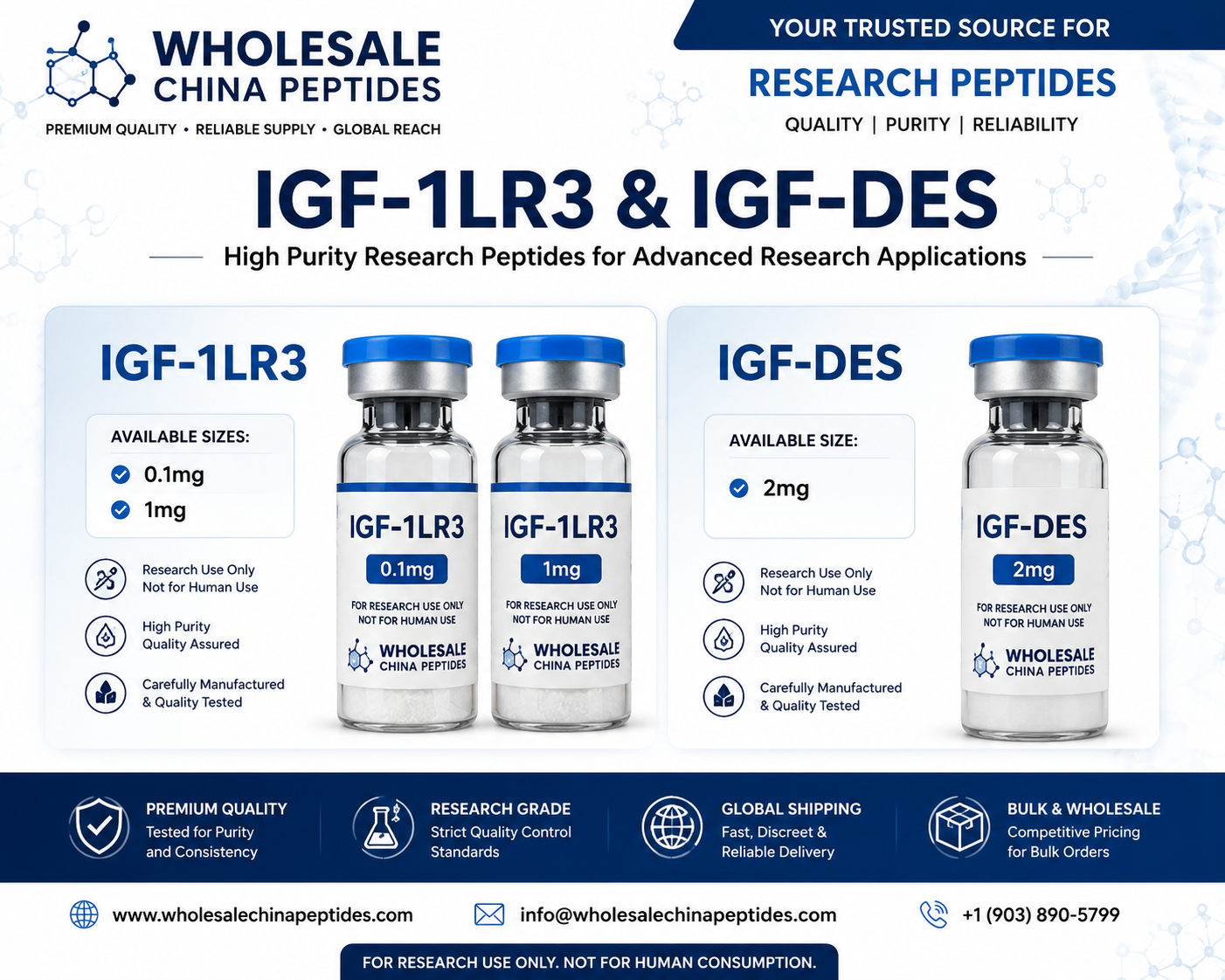
igf-1 des and IGF-1 LR3 Research Peptides
Price range: $66.00 through $500.00
Quality Considerations When Sourcing igf-1 des and IGF-1 LR3
For research institutions, laboratories, and wholesale buyers, peptide quality is one of the most important considerations. When purchasing igf-1 des or IGF-1 LR3, buyers should look for suppliers that prioritize transparency, testing, and consistency.
Important quality factors include:
High Purity Standards
Research peptides should be produced with high purity standards to support reliable experimental results. Many laboratories prefer peptides tested by HPLC or similar analytical methods.
Batch Documentation
A reputable peptide supplier should provide batch-related information such as purity reports, testing data, or certificates of analysis when available.
Proper Packaging
Peptides such as igf-1 des and IGF-1 LR3 require careful packaging to help maintain product integrity during shipping and storage.
Reliable Wholesale Supply
For distributors, research organizations, and bulk buyers, consistent supply is essential. Wholesale sourcing helps support repeat purchasing and inventory planning.
At Wholesale China Peptides, customers looking for research peptides can explore bulk and wholesale options for laboratory-use compounds, including IGF-related peptides.
igf-1 des and IGF-1 LR3: Research Peptide Overview for Laboratory Applications
In the field of peptide research, IGF-1 analogs are widely studied for their role in cellular signaling, growth-factor pathways, and receptor interaction. Two of the most commonly discussed compounds in this category are IGF-1 LR3 and IGF-1 DES, also searched as igf-1 des or IGF-DES. These modified versions of insulin-like growth factor 1 are used in controlled laboratory environments to help researchers better understand biological mechanisms related to cell communication, protein signaling, and tissue-related research models.
At Wholesale China Peptides — https://wholesalechinapeptides.com/ — researchers and wholesale buyers can explore peptide categories designed for laboratory and research purposes. When evaluating products such as igf-1 des and IGF-1 LR3, quality, purity, documentation, and reliable sourcing are essential factors.
Important note: IGF-1 DES and IGF-1 LR3 are intended for research use only. They are not intended for human consumption, medical use, bodybuilding use, or veterinary use.
What Is igf-1 des?
igf-1 des, also known as IGF-1 DES(1-3), is a shortened analog of naturally occurring IGF-1. The term “DES” refers to the absence of the first three amino acids at the N-terminal end of the peptide chain. This structural modification makes igf-1 des different from standard IGF-1 and contributes to its unique behavior in research settings.
In laboratory studies, igf-1 des is often investigated for its interaction with IGF-1 receptors and its reduced binding affinity to IGF-binding proteins. IGF-binding proteins can influence how much free IGF-1 is available to interact with receptors. Because igf-1 des has a modified structure, researchers may study it to better understand receptor activation, localized signaling, and cell-response pathways.
This makes igf-1 des a valuable research tool in controlled experiments involving cellular growth signaling, regenerative science models, and molecular biology studies.
What Is IGF-1 LR3?
IGF-1 LR3, sometimes written as IGF-1LR3, stands for Long R3 Insulin-like Growth Factor 1. It is another modified form of IGF-1, designed with an amino acid substitution and an extended peptide chain. Compared with natural IGF-1, IGF-1 LR3 is known in research discussions for having reduced interaction with IGF-binding proteins and a longer activity profile in certain laboratory models.
While igf-1 des is often associated with shorter, more localized research activity, IGF-1 LR3 is commonly studied in broader research models involving cell signaling, growth-factor pathways, and metabolic response mechanisms. Both peptides are important for researchers who want to compare how structural changes in IGF-1 analogs affect biological activity.
igf-1 des vs IGF-1 LR3: Key Differences
Although both peptides are IGF-1 analogs, igf des and IGF-1 LR3 are not identical. Their structural differences influence how they are studied in laboratory environments.
1. Peptide Structure
igf-1 des is a truncated version of IGF-1, missing the first three amino acids. IGF-1 LR3 includes an arginine substitution and a longer amino acid sequence. These differences are important because even small peptide modifications can influence receptor binding and biological behavior.
2. Research Activity Profile
In research literature and peptide discussions, igf-1 des is often described as having a more localized and shorter activity profile. IGF-1 LR3, on the other hand, is generally studied for longer-duration activity in experimental models.
3. Binding Protein Interaction
Both igf-1 des and IGF-1 LR3 are studied because they show reduced binding to IGF-binding proteins compared with native IGF-1. This characteristic can help researchers examine receptor availability and signal transduction more clearly.
4. Laboratory Applications
igf-1 des is commonly researched in models involving localized cell response and receptor interaction. IGF-1 LR3 is often used in broader studies focused on growth-factor signaling, cell proliferation pathways, and metabolic research.
Why Researchers Study igf-1 des
The increasing interest in igf-1 des comes from its specific structure and research potential. Because it differs from native IGF-1, it allows scientists to study how modifications to peptide chains affect receptor behavior and cellular signaling.
Common research areas involving igf-1 des include:
- IGF-1 receptor interaction studies
- Cellular signaling pathway research
- Tissue-model investigations
- Protein synthesis pathway analysis
- Molecular biology experiments
- Comparative peptide analog studies
Researchers may also compare igf-1 des with IGF-1 LR3 to evaluate differences in binding, stability, and activity in laboratory models. These comparisons help expand scientific understanding of how growth-factor peptides function at the cellular level.
Quality Considerations When Sourcing igf-1 des and IGF-1 LR3
For research institutions, laboratories, and wholesale buyers, peptide quality is one of the most important considerations. When purchasing igf des or IGF-1 LR3, buyers should look for suppliers that prioritize transparency, testing, and consistency.
Important quality factors include:
High Purity Standards
Research peptides should be produced with high purity standards to support reliable experimental results. Many laboratories prefer peptides tested by HPLC or similar analytical methods.
Batch Documentation
A reputable peptide supplier should provide batch-related information such as purity reports, testing data, or certificates of analysis when available.
Proper Packaging
Peptides such as igf-1 des and IGF-1 LR3 require careful packaging to help maintain product integrity during shipping and storage.
Reliable Wholesale Supply
For distributors, research organizations, and bulk buyers, consistent supply is essential. Wholesale sourcing helps support repeat purchasing and inventory planning.
At Wholesale China Peptides, customers looking for research peptides can explore bulk and wholesale options for laboratory-use compounds, including IGF-related peptides.
Research-Use Disclaimer for IGF-1 DES and IGF-1 LR3
It is important to clearly state that igf des and IGF-1 LR3 are research chemicals. They are not approved for self-administration, medical treatment, performance enhancement, or cosmetic use. Any content discussing these peptides should be understood strictly from a scientific and laboratory-research perspective.
Researchers should follow all applicable local laws, institutional guidelines, laboratory safety protocols, and ethical standards when handling IGF-1 analogs.
Conclusion
igf des and IGF-1 LR3 are two important IGF-1 analogs studied for their role in receptor binding, cell signaling, and growth-factor research. While igf-1 des is a shortened form of IGF-1 missing the first three amino acids, IGF-1 LR3 is a longer modified analog with a different research activity profile. Both compounds offer value in controlled laboratory studies, especially when researchers need to compare IGF-1 variants and their biological behavior.
For buyers seeking reliable research peptide sourcing, Wholesale China Peptides provides a platform for exploring wholesale peptide options for laboratory applications. Whether comparing igf des with IGF-1 LR3 or evaluating IGF-related peptides for research purposes, choosing quality-tested products from a dependable supplier is essential for consistent and accurate research outcomes.
| Choose An Option | IGF-1 LR3 0.1mg*10vials, IGF-1 LR3 1mg*10vials, IGF-DES 2mg*10vials |
|---|
Be the first to review “igf-1 des and IGF-1 LR3 Research Peptides”
Related products

Cognitive & Neurological Research Peptides
Cognitive & Neurological Research Peptides
Cognitive & Neurological Research Peptides

Healing & Recovery Peptides

Healing & Recovery Peptides

Growth Hormone Secretagogues

Healing & Recovery Peptides

Cognitive & Neurological Research Peptides
Reviews
There are no reviews yet.