
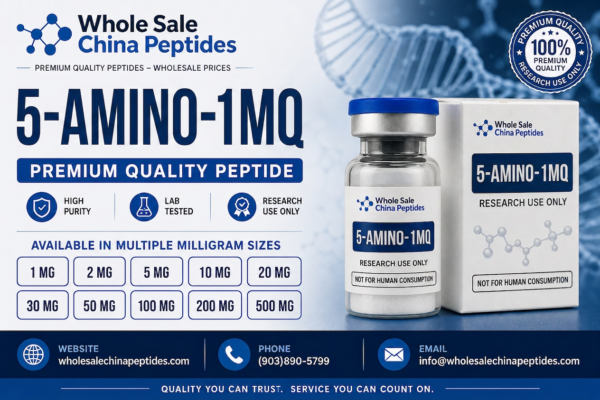
5-Amino-1MQ Peptide
Price range: $65.00 through $220.00
5-Amino-1MQ Peptide: Chemical Composition & Structure
Molecular Formula:
C₁₀H₁₁N₃
Molecular Weight:
173.21 g/mol
Chemical Structure:
   NH₂
    |
  N⁺─C₆H₃─N
    |     |
   CH₃    CH
          |
         CH─CH
Key Structural Features:
- Quinolinium core – Provides structural stability and receptor affinity
- Methyl group (CH₃) – Critical for NNMT inhibition
- Amino group (NH₂) – Enhances solubility and biological activity
- Small molecule size – Allows for efficient cellular uptake and tissue penetration
- Positive charge (N⁺) – Facilitates interaction with negatively charged cellular components
Chemical Properties:
| Property | Details |
|---|---|
| Solubility | Water-soluble (reconstitute with bacteriostatic water) |
| Storage (Lyophilized) | -20°C (stable for 2+ years) |
| Storage (Reconstituted) | 2-8°C (stable for 7-14 days) |
| Half-Life | ~4-6 hours (oral), ~2-4 hours (IV) |
| Purity | ≥98% (HPLC-verified) |
5-Amino-1MQ Peptide: A Comprehensive Research Guide to Next-Generation Metabolic Therapy
Introduction to 5-Amino-1MQ Peptide
5 Amino 1MQ (5-amino-1-methylquinolinium) is a synthetic small-molecule peptide mimetic that has emerged as a groundbreaking compound in metabolic research. This novel nicotinamide N-methyltransferase (NNMT) inhibitor has shown remarkable potential in promoting fat loss, enhancing metabolic function, and improving body composition by targeting adipose tissue metabolism.
At Wholesale China Peptides, researchers can access high-purity 5 amino 1MQ peptide for controlled laboratory studies. This 1000+ word guide covers everything scientists need to know about 5 amino 1MQ, including its chemical composition, mechanisms of action, research benefits, dosage protocols, and safety considerations.
What Is 5-Amino-1MQ Peptide?
5-Amino-1MQ is a small-molecule inhibitor of nicotinamide N-methyltransferase (NNMT), an enzyme that plays a critical role in regulating cellular metabolism and energy homeostasis. By inhibiting NNMT, 5-amino-1MQ enhances NAD+ levels, boosts metabolic rate, and promotes fat oxidation, making it a powerful tool for obesity and metabolic disorder research.
Key Features of 5 Amino 1MQ:
✅ NNMT inhibition – Blocks nicotinamide N-methyltransferase to enhance metabolism
✅ Fat loss acceleration – Promotes lipolysis and reduces adiposity
✅ Metabolic rate enhancement – Increases energy expenditure and thermogenesis
✅ Insulin sensitivity improvement – Enhances glucose metabolism and reduces insulin resistance
✅ NAD+ level elevation – Boosts cellular energy production and longevity pathways
✅ Muscle preservation – Prevents muscle loss during fat loss
5-Amino-1MQ Peptide Benefits in Research
5 Amino 1MQ is studied for its potential therapeutic applications in multiple fields:
1. Obesity & Weight Management Research
- Fat loss acceleration – Enhances lipolysis and reduces body fat
- Body recomposition – Improves fat-to-muscle ratio
- Visceral fat reduction – Targets abdominal and organ fat
- Appetite regulation – May reduce food intake and cravings
2. Metabolic Disorder Research
- Type 2 diabetes – Improves insulin sensitivity and glucose metabolism
- Metabolic syndrome – Reduces multiple metabolic risk factors
- Non-alcoholic fatty liver disease (NAFLD) – Decreases hepatic steatosis and inflammation
- Lipid profile optimization – Lowers triglycerides and LDL cholesterol
3. Performance & Body Composition Research
- Athletic performance enhancement – Improves endurance and recovery
- Muscle preservation – Prevents muscle loss during caloric restriction
- Energy metabolism optimization – Enhances mitochondrial function and ATP production
- Recovery optimization – Accelerates post-exercise recovery
4. Aging & Longevity Research
- NAD+ level elevation – Activates sirtuins and longevity pathways
- Oxidative stress reduction – Protects against cellular damage and aging
- Metabolic health improvement – Reduces age-related metabolic decline
- Lifespan extension – Studied in animal models for longevity benefits
5. Neurological & Cognitive Research
- Neuroprotection – Protects against neurodegenerative diseases
- Cognitive enhancement – Improves memory, learning, and focus
- Neuroinflammation reduction – Lowers pro-inflammatory cytokines in the brain
- Mood regulation – May improve symptoms of depression and anxiety
5-Amino-1MQ Peptide: Chemical Composition & Structure
Molecular Formula:
C₁₀H₁₁N₃
Molecular Weight:
173.21 g/mol
Chemical Structure:
   NH₂
    |
  N⁺─C₆H₃─N
    |     |
   CH₃    CH
          |
         CH─CH
Key Structural Features:
- Quinolinium core – Provides structural stability and receptor affinity
- Methyl group (CH₃) – Critical for NNMT inhibition
- Amino group (NH₂) – Enhances solubility and biological activity
- Small molecule size – Allows for efficient cellular uptake and tissue penetration
- Positive charge (N⁺) – Facilitates interaction with negatively charged cellular components
Chemical Properties:
| Property | Details |
|---|---|
| Solubility | Water-soluble (reconstitute with bacteriostatic water) |
| Storage (Lyophilized) | -20°C (stable for 2+ years) |
| Storage (Reconstituted) | 2-8°C (stable for 7-14 days) |
| Half-Life | ~4-6 hours (oral), ~2-4 hours (IV) |
| Purity | ≥98% (HPLC-verified) |
How 5-Amino-1MQ Works: Mechanisms of Action
5 Amino 1MQ exerts its effects primarily through inhibition of nicotinamide N-methyltransferase (NNMT), which triggers multiple metabolic and cellular pathways that enhance fat loss and metabolic function.
1. NNMT Inhibition & NAD+ Elevation
- NNMT blockade – 5-Amino-1MQ binds to and inhibits NNMT
- Nicotinamide accumulation – Prevents methylation of nicotinamide (NAM)
- NAD+ salvage pathway activation – Increases conversion of NAM to NAD+
- NAD+ level elevation – Boosts cellular NAD+ concentrations
2. Metabolic Rate Enhancement
- Sirtuin activation – NAD+ activates sirtuins (SIRT1, SIRT3, SIRT6), which enhance mitochondrial function
- AMPK activation – Increases AMP-activated protein kinase (AMPK) activity, promoting fat oxidation and glucose uptake
- Thermogenesis – Enhances brown adipose tissue (BAT) activity and heat production
- Mitochondrial biogenesis – Increases number and function of mitochondria
3. Fat Metabolism & Lipolysis
- Lipolysis stimulation – Activates hormone-sensitive lipase (HSL) for fat breakdown
- Fatty acid oxidation – Increases fat utilization as energy
- Adipogenesis inhibition – Reduces formation of new fat cells
- Visceral fat reduction – Targets abdominal and organ fat
4. Insulin Sensitivity Improvement
- Glucose uptake enhancement – Improves insulin-mediated glucose transport in muscle and fat cells
- Gluconeogenesis reduction – Decreases hepatic glucose production
- Insulin resistance reversal – Lowers blood glucose levels and improves metabolic function
5. Muscle Preservation & Performance
- Protein synthesis enhancement – Supports muscle growth and repair
- Muscle catabolism inhibition – Prevents muscle breakdown during fat loss
- Recovery optimization – Accelerates post-exercise muscle repair
- Endurance improvement – Enhances mitochondrial function and energy production
5-Amino-1MQ Peptide Dosage Protocols for Research
Since 5 amino 1MQ is not approved for human use, dosage guidelines are based on preclinical and research models. Researchers should adjust protocols based on study objectives.
General Dosage Guidelines
| Study Type | Dosage Range | Administration Route | Frequency | Study Duration |
|---|---|---|---|---|
| Obesity Research | 1-10 mg/kg | Oral or Intraperitoneal (IP) | Daily | 4-12 weeks |
| Metabolic Research | 1-5 mg/kg | Oral or IP | Daily | 4-8 weeks |
| Performance Research | 1-10 mg/kg | Oral or Subcutaneous (SC) | Daily | 4-8 weeks |
| Aging Research | 1-5 mg/kg | Oral or IP | Daily | 8-16 weeks |
| Neurological Research | 1-10 mg/kg | Oral or IP | Daily | 4-8 weeks |
Key Dosage Considerations
✔ Start with lower doses (1 mg/kg) to assess tolerance and efficacy
✔ Monitor metabolic parameters (e.g., glucose, insulin, lipids, body composition)
✔ Adjust administration route based on study objectives (e.g., oral for chronic studies, IP for acute effects)
✔ Combine with lifestyle interventions (diet, exercise) for enhanced results
✔ Cycle 5-amino-1MQ to prevent tolerance and maintain efficacy
Potential Side Effects & Safety Considerations
While 5 amino 1MQ is generally well-tolerated in research, potential side effects should be monitored:
Common Side Effects (Observed in Animal Models)
| Side Effect | Cause | Mitigation Strategy |
|---|---|---|
| Mild nausea | Gastrointestinal effects | Administer with food |
| Transient fatigue | Metabolic adaptation | Reduce dose if severe |
| Headache | Neurochemical modulation | Reduce dose if persistent |
| Injection site irritation | Subcutaneous administration | Rotate injection sites |
Long-Term Considerations
⚠ Metabolic adaptation – Prolonged use may alter baseline metabolism
⚠ NAD+ overproduction – May lead to redox imbalance in some tissues
⚠ Drug interactions – May enhance effects of metabolic or fat-loss agents
⚠ Tissue-specific effects – May differentially affect various organs (e.g., liver, muscle, brain)
Where to Buy High-Quality 5 Amino 1MQ Peptide for Research
For researchers seeking pharmaceutical-grade 5-amino-1MQ peptide, Wholesale China Peptides offers:
✅ ≥98% Purity (HPLC-verified)
✅ Lyophilized for long-term stability
✅ Batch-specific COAs (Certificate of Analysis)
✅ Bulk & wholesale pricing for institutions
✅ Secure, discreet shipping worldwide
Note: 5 amino 1MQ peptide is for research use only—not for human consumption, medical treatment, or performance enhancement.
Conclusion: Why 5-Amino-1MQ Peptide is a Game-Changer in Metabolic Research
5 Amino 1MQ represents a paradigm shift in metabolic and obesity research, offering a novel approach to fat loss, metabolic enhancement, and longevity. Its ability to inhibit NNMT, elevate NAD+ levels, and boost metabolic rate makes it a valuable tool for studying:
✔ Obesity and weight management (fat loss, body recomposition, visceral fat reduction)
✔ Metabolic disorders (type 2 diabetes, metabolic syndrome, NAFLD)
✔ Performance and body composition (athletic enhancement, muscle preservation, recovery)
✔ Aging and longevity (NAD+ elevation, oxidative stress reduction, lifespan extension)
✔ Neurological and cognitive health (neuroprotection, cognitive enhancement, mood regulation)
For researchers looking to advance metabolic, obesity, and performance studies, Wholesale China Peptides provides high-purity 5 amino 1MQ peptide at competitive prices.
Disclaimer: This article is for educational and research purposes only. 5 amino 1MQ peptide is not approved for human use and should only be used in IRB-approved laboratory settings.
Ready to Advance Your Metabolic Research with 5 Amino 1MQ?
🔹 Visit Wholesale China Peptides
🔹 Request a COA before purchasing
🔹 Consult with a research advisor for proper dosing protocols
5-amino-1mq
5 amino 1mq peptide
5 amino 1mq dosage
5 amino 1mq benefits
5-amino 1mq
5-amino-1mq dosage
5-amino-1mq side effects
5-amino-1mq peptide
5-amino-1mq before and after
| Choose An Option | 5mg*10vials, 10mg*10vials, 30mg*10vials |
|---|
Be the first to review “5-Amino-1MQ Peptide”
Related products

Healing & Recovery Peptides
Anti-Aging & Longevity Research Peptides

Growth Hormone Secretagogues

GLP-1 & Metabolic Research Peptides

Healing & Recovery Peptides

Growth Hormone Secretagogues
Anti-Aging & Longevity Research Peptides
Healing & Recovery Peptides
Reviews
There are no reviews yet.