
hgh frag 176-191|HGH|hgh online
Price range: $60.00 through $100.00
Mechanism of Action: How HGH Frag 176-191 Differs from Full-Length hGH
The scientific rationale for studying HGH Frag 176-191 lies in its selective biological activity. While full-length hGH binds to growth hormone receptors and activates a broad range of signaling pathways—including those influencing insulin sensitivity, IGF-1 production, and cellular proliferation—the 176-191 fragment is believed to act more selectively on lipid metabolism pathways.
Key Hypothesized Activities:
-
Lipolysis Stimulation: The peptide is thought to promote the breakdown of stored fat (lipolysis) by enhancing the expression of lipolytic enzymes.
-
Lipogenesis Inhibition: It may also inhibit the formation of new fat deposits (lipogenesis).
-
Minimal Impact on GH Receptor Signaling: Unlike full-length hGH, this fragment does not significantly impact insulin or IGF-1 levels, making it a potential tool for studying fat metabolism in isolation.
Early research in rat models demonstrated that synthetic peptides corresponding to the C-terminal region of hGH (including residues 172-191 and 176-191) produced a short-lived rise in blood glucose and a sustained rise in plasma insulin, suggesting metabolic activity distinct from full-length hGH.
HGH Frag 176-191: Research Protocols, Mechanisms, and Dosing Strategies
Meta Description: Explore the science of HGH Frag 176-191, a peptide fragment of human growth hormone studied for lipid metabolism. Review research protocols, dosing considerations, and product availability for laboratory use.
What is HGH Frag 176-191?
HGH Frag 176-191, also known as AOD-9604, is a synthetic peptide fragment derived from the C-terminal region of the human growth hormone (hGH) molecule. It consists of the final 16 amino acids of the 191-amino acid hGH chain (residues 176-191), sometimes modified with an additional tyrosine residue at the N-terminus to support stability and activity.
What makes this peptide of significant research interest is its hypothesized ability to selectively target pathways involved in lipid metabolism without producing the adverse effects on blood sugar or growth associated with full-length hGH. For researchers investigating metabolic regulation, fat metabolism, and tissue regeneration, understanding the appropriate protocols for hgh frag 176-191 is essential.
Please note that HGH Frag 176-191 is a research compound and is not approved for human use. It is considered a performance-enhancing drug (PED) and is subject to regulatory scrutiny.
Mechanism of Action: How HGH Frag 176-191 Differs from Full-Length hGH
The scientific rationale for studying HGH Frag 176-191 lies in its selective biological activity. While full-length hGH binds to growth hormone receptors and activates a broad range of signaling pathways—including those influencing insulin sensitivity, IGF-1 production, and cellular proliferation—the 176-191 fragment is believed to act more selectively on lipid metabolism pathways.
Key Hypothesized Activities:
-
Lipolysis Stimulation: The peptide is thought to promote the breakdown of stored fat (lipolysis) by enhancing the expression of lipolytic enzymes.
-
Lipogenesis Inhibition: It may also inhibit the formation of new fat deposits (lipogenesis).
-
Minimal Impact on GH Receptor Signaling: Unlike full-length hGH, this fragment does not significantly impact insulin or IGF-1 levels, making it a potential tool for studying fat metabolism in isolation.
Early research in rat models demonstrated that synthetic peptides corresponding to the C-terminal region of hGH (including residues 172-191 and 176-191) produced a short-lived rise in blood glucose and a sustained rise in plasma insulin, suggesting metabolic activity distinct from full-length hGH.
HGH Frag 176-191 Research Protocols and Dosing
When designing research protocols involving HGH Frag 176-191, it is important to consider the peptide’s short half-life, commonly cited as approximately 30 minutes. This pharmacokinetic profile influences dosing frequency in research models.
Commonly Encountered Dosing Protocols:
Dosing patterns found in research and self-administration literature typically fall within the range of 250-500 mcg per day, divided into two doses.
-
Morning Dose: Often administered upon waking with a completely empty stomach, followed by a 4-hour fasting period. Breaking the fast is believed to reduce the peptide’s effects.
-
Evening Dose: A second dose is sometimes administered before bed, 3-4 hours after the last meal.
Considerations for Research Design:
-
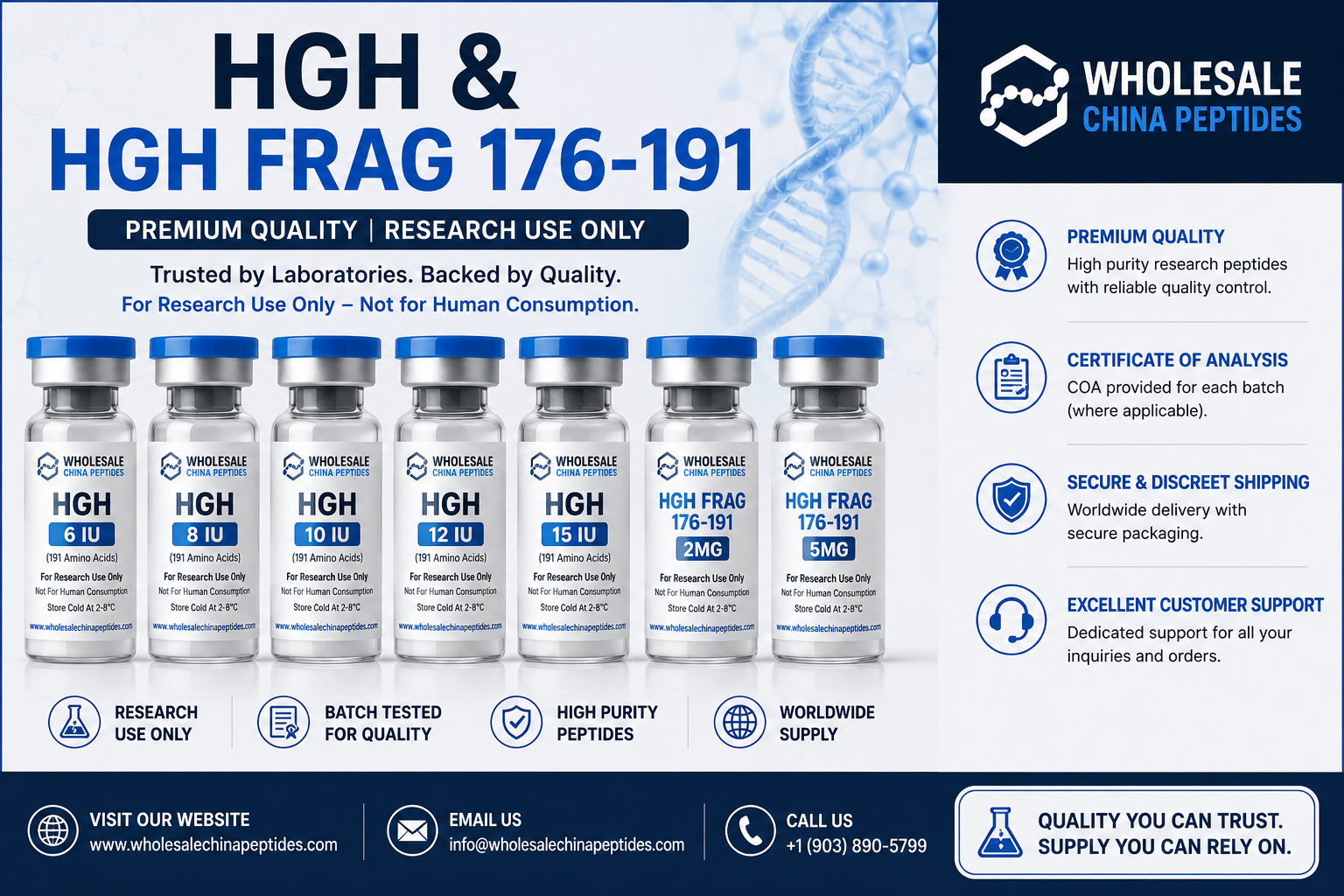
Product Formats: HGH Frag 176-191 is commonly supplied in lyophilized vials containing 2 mg or 5 mg of the peptide.
-
Cycle Length: Research protocols often span 8-12 weeks.
-
Reconstitution: As with other research peptides, proper reconstitution using bacteriostatic water and refrigeration after reconstitution is recommended to maintain peptide integrity.
It is critical to note that studies in human subjects have shown variable results. One trial with 10 subjects receiving a daily subcutaneous dose of 2 International Units (IU) of the 176-191 fragment for four weeks reported no significant reduction in body fat, though subjects reported feeling more energetic. Another trial with eight male and two female subjects reported significant weight loss and body fat reduction. This variability underscores the need for further research.
HGH Frag 176-191 vs. AOD-9604: Understanding the Relationship
HGH Frag 176-191 and AOD-9604 are often used interchangeably in research discussions, though there is a subtle distinction. AOD-9604 is considered a modified version of the 176-191 fragment, featuring an additional tyrosine residue at the N-terminus designed to enhance stability and activity. Both are derived from the same region of the hGH molecule and are studied for similar metabolic effects.
Regulatory Status and Safety Considerations
Important Research Use Notice: HGH Frag 176-191 is categorized among unregulated peptides marketed as “research compounds.” It is not approved by regulatory agencies like the FDA for human use and has not been evaluated for safety or efficacy in approved clinical trials for physique or performance-related indications.
Reported Considerations:
-
Endocrine and Metabolic Effects: Reported adverse events in related compounds include prolactin and cortisol elevations, appetite changes, and dysglycaemia.
-
Injection-Site Reactions: Local reactions at the injection site are common.
-
Product Uncertainty: The unregulated supply chain introduces uncertainty regarding product composition, dosing, and stacking practices.
Why Choose Wholesale China Peptides for Your Research?
At Wholesale China Peptides, we are committed to supporting the scientific community with high-purity research peptides. Our HGH Frag 176-191 products are manufactured to rigorous quality standards, ensuring researchers have access to reliable materials for their investigations into metabolic regulation and lipid metabolism pathways.
Disclaimer: This content is for informational and educational purposes only and is not intended as medical advice. The products mentioned are strictly for research purposes and are not for human consumption. Please consult with a qualified professional and review all relevant regulatory guidelines before commencing any research.
| Choose An Option | HGH 6iu*10vials, HGH 8iu*10vials, HGH 10iu*10vials, HGH 12iu*10vials, HGH 15iu*10vials, HGH 176-191 2mg*10vials, HGH 176-191 5mg*10vials |
|---|
Be the first to review “hgh frag 176-191|HGH|hgh online”
Related products

GLP-1 & Metabolic Research Peptides

Healing & Recovery Peptides

GLP-1 & Metabolic Research Peptides

Healing & Recovery Peptides

GLP-1 & Metabolic Research Peptides

Anti-Aging & Longevity Research Peptides
Growth Hormone Secretagogues
Anti-Aging & Longevity Research Peptides
Reviews
There are no reviews yet.