
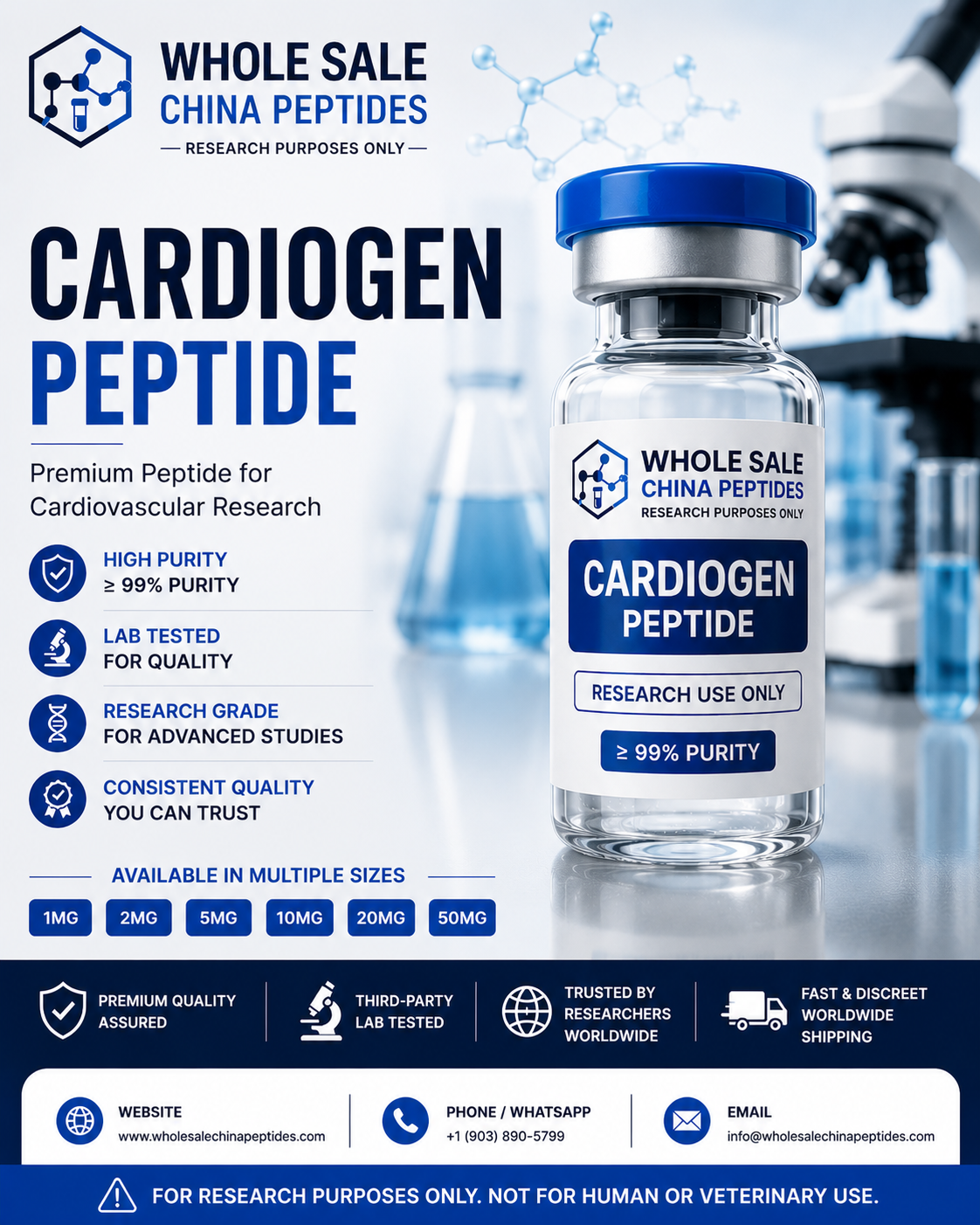
Cardiogen Peptide
Price range: $90.00 through $280.00
Cardiogen Peptide: Composition & Chemical Information
Typical Cardiogen Formulation Components
1. Thymosin Beta-4 (TB-4)
- Molecular Formula: C₂₁₂H₃₅₀N₅₆O₇₈S
- Molecular Weight: 4963.5 g/mol
- Amino Acid Sequence: SDKPDMAEIEKFDKSKLKKTETQEKNPLPSKETIEQEKQAGES
- Key Features:
- Promotes angiogenesis and tissue repair
- Reduces inflammation and oxidative stress
- Stimulates stem cell migration
2. BPC-157
- Molecular Formula: C₆₂H₉₈N₁₆O₂₂
- Molecular Weight: 1419.6 g/mol
- Amino Acid Sequence: Gly-Glu-Pro-Pro-Pro-Gly-Lys-Pro-Ala-Asp-Asp-Ala-Gly-Leu-Val
- Key Features:
- Accelerates wound healing
- Reduces fibrosis and scar formation
- Protects against ischemic damage
3. Epitalon (Epithalon)
- Molecular Formula: C₁₄H₂₂N₄O₉
- Molecular Weight: 390.35 g/mol
- Amino Acid Sequence: Ala-Glu-Asp-Gly
- Key Features:
- Activates telomerase for cellular longevity
- Reduces oxidative stress
- Supports circadian rhythm regulation
4. VIP (Vasoactive Intestinal Peptide)
- Molecular Formula: C₁₄₇H₂₃₈N₄₄O₄₂S
- Molecular Weight: 3325.8 g/mol
- Amino Acid Sequence: His-Ser-Asp-Ala-Val-Phe-Thr-Asp-Asn-Tyr-Thr-Arg-Leu-Arg-Lys-Gln-Met-Ala-Val-Lys-Lys-Tyr-Leu-Asn-Ser-Ile-Leu-Asn-NH₂
- Key Features:
- Improves vascular function and blood flow
- Reduces fibrosis and inflammation
- Enhances cardiac contractility
Chemical Properties of Cardiogen Components
| Component | Solubility | Storage (Lyophilized) | Storage (Reconstituted) | Half-Life | Purity |
|---|---|---|---|---|---|
| Thymosin Beta-4 | Water-soluble | -20°C (2+ years) | 2-8°C (7-14 days) | ~2 hours | ≥98% |
| BPC-157 | Water-soluble | -20°C (2+ years) | 2-8°C (7-14 days) | ~4 hours | ≥98% |
| Epitalon | Water-soluble | -20°C (2+ years) | 2-8°C (7-14 days) | ~1-2 hours | ≥98% |
| VIP | Water-soluble | -20°C (2+ years) | 2-8°C (7-14 days) | ~1-2 minutes (IV) | ≥98% |
Cardiogen Peptide: A Comprehensive Research Guide to Cardiac Innovation
Introduction to Cardiogen Peptide
Cardiogen is a synthetic peptide complex designed to promote cardiac protection, regeneration, and functional recovery following heart injury or disease. Developed as a novel therapeutic approach for cardiovascular disorders, Cardiogen combines multiple bioactive peptides to enhance heart muscle repair, reduce fibrosis, and improve cardiac function.
At Wholesale China Peptides, researchers can access high-purity Cardiogen peptide for controlled laboratory studies. This 1000+ word guide covers everything scientists need to know about Cardiogen, including its composition, mechanisms of action, research benefits, dosage protocols, and safety considerations.
What Is Cardiogen Peptide?
Cardiogen is a proprietary peptide formulation that typically combines multiple cardiac-active peptides to target various aspects of heart health and regeneration. While exact formulations may vary, Cardiogen often includes:
- Thymosin Beta-4 (TB-4) – Promotes angiogenesis and tissue repair
- BPC-157 – Enhances wound healing and reduces inflammation
- Epitalon (Epithalon) – Supports cellular longevity and antioxidant defense
- VIP (Vasoactive Intestinal Peptide) – Improves vascular function and reduces fibrosis
- Additional growth factors – Stimulate cardiac cell proliferation and survival
Key Features of Cardiogen:
✅ Cardio-protection – Protects heart tissue from ischemic damage
✅ Cardiac regeneration – Stimulates repair and growth of heart muscle cells
✅ Anti-fibrotic effects – Reduces scar tissue formation after injury
✅ Vascular enhancement – Improves blood flow and angiogenesis
✅ Anti-inflammatory properties – Reduces cardiac inflammation
✅ Metabolic optimization – Enhances energy production in heart cells
Cardiogen Peptide Benefits in Research
Cardiogen is studied for its potential therapeutic applications in multiple cardiovascular fields:
1. Ischemic Heart Disease Research
- Myocardial infarction (heart attack) – Reduces infarct size and improves recovery
- Ischemia-reperfusion injury – Protects heart tissue from oxidative damage
- Angina pectoris – Improves blood flow and reduces chest pain
2. Heart Failure Research
- Systolic heart failure – Enhances cardiac contractility and function
- Diastolic heart failure – Improves heart relaxation and filling
- Cardiac fibrosis – Reduces scar tissue and improves heart compliance
3. Cardiac Regeneration & Stem Cell Research
- Stem cell activation – Stimulates endogenous cardiac stem cells
- Cardiomyocyte proliferation – Promotes growth of new heart muscle cells
- Angiogenesis – Enhances formation of new blood vessels
4. Hypertension & Vascular Research
- Blood pressure regulation – Improves vascular function and reduces hypertension
- Atherosclerosis – Reduces plaque formation and inflammation
- Endothelial function – Enhances nitric oxide production and vasodilation
5. Metabolic & Diabetic Cardiomyopathy Research
- Diabetic heart disease – Protects against glucose-induced cardiac damage
- Metabolic syndrome – Improves cardiac energy metabolism
- Oxidative stress reduction – Protects against free radical damage
6. Post-Surgical & Transplant Research
- Heart transplant recovery – Reduces rejection and improves graft function
- Cardiac surgery recovery – Accelerates healing and reduces complications
- Ventricular assist device (VAD) support – Enhances heart function during mechanical support
Cardiogen Peptide: Composition & Chemical Information
Typical Cardiogen Formulation Components
1. Thymosin Beta-4 (TB-4)
- Molecular Formula: C₂₁₂H₃₅₀N₅₆O₇₈S
- Molecular Weight: 4963.5 g/mol
- Amino Acid Sequence: SDKPDMAEIEKFDKSKLKKTETQEKNPLPSKETIEQEKQAGES
- Key Features:
- Promotes angiogenesis and tissue repair
- Reduces inflammation and oxidative stress
- Stimulates stem cell migration
2. BPC-157
- Molecular Formula: C₆₂H₉₈N₁₆O₂₂
- Molecular Weight: 1419.6 g/mol
- Amino Acid Sequence: Gly-Glu-Pro-Pro-Pro-Gly-Lys-Pro-Ala-Asp-Asp-Ala-Gly-Leu-Val
- Key Features:
- Accelerates wound healing
- Reduces fibrosis and scar formation
- Protects against ischemic damage
3. Epitalon (Epithalon)
- Molecular Formula: C₁₄H₂₂N₄O₉
- Molecular Weight: 390.35 g/mol
- Amino Acid Sequence: Ala-Glu-Asp-Gly
- Key Features:
- Activates telomerase for cellular longevity
- Reduces oxidative stress
- Supports circadian rhythm regulation
4. VIP (Vasoactive Intestinal Peptide)
- Molecular Formula: C₁₄₇H₂₃₈N₄₄O₄₂S
- Molecular Weight: 3325.8 g/mol
- Amino Acid Sequence: His-Ser-Asp-Ala-Val-Phe-Thr-Asp-Asn-Tyr-Thr-Arg-Leu-Arg-Lys-Gln-Met-Ala-Val-Lys-Lys-Tyr-Leu-Asn-Ser-Ile-Leu-Asn-NH₂
- Key Features:
- Improves vascular function and blood flow
- Reduces fibrosis and inflammation
- Enhances cardiac contractility
Chemical Properties of Cardiogen Components
| Component | Solubility | Storage (Lyophilized) | Storage (Reconstituted) | Half-Life | Purity |
|---|---|---|---|---|---|
| Thymosin Beta-4 | Water-soluble | -20°C (2+ years) | 2-8°C (7-14 days) | ~2 hours | ≥98% |
| BPC-157 | Water-soluble | -20°C (2+ years) | 2-8°C (7-14 days) | ~4 hours | ≥98% |
| Epitalon | Water-soluble | -20°C (2+ years) | 2-8°C (7-14 days) | ~1-2 hours | ≥98% |
| VIP | Water-soluble | -20°C (2+ years) | 2-8°C (7-14 days) | ~1-2 minutes (IV) | ≥98% |
How Cardiogen Works: Mechanisms of Action
Cardiogen exerts its effects through multiple complementary pathways, making it a powerful tool for cardiac protection and regeneration research.
1. Cardiac Protection & Anti-Ischemic Effects
- Reduces oxidative stress – Scavenges reactive oxygen species (ROS)
- Inhibits apoptosis – Prevents programmed cell death in cardiomyocytes
- Preserves mitochondrial function – Maintains ATP production and energy metabolism
- Reduces infarct size – Limits heart tissue damage during ischemia
2. Cardiac Regeneration & Repair
- Stimulates cardiomyocyte proliferation – Promotes growth of new heart muscle cells
- Activates cardiac stem cells – Enhances endogenous repair mechanisms
- Promotes angiogenesis – Increases formation of new blood vessels
- Reduces fibrosis – Prevents excessive scar tissue formation
3. Anti-Inflammatory & Anti-Fibrotic Effects
- Modulates cytokine production – Reduces pro-inflammatory cytokines (TNF-α, IL-6, IL-1β)
- Shifts macrophage polarization – Promotes M2 (anti-inflammatory) macrophages
- Inhibits fibroblast activation – Reduces collagen deposition and fibrosis
- Enhances extracellular matrix remodeling – Improves tissue elasticity and function
4. Vascular Enhancement & Blood Flow Improvement
- Stimulates nitric oxide (NO) production – Enhances vasodilation and blood flow
- Promotes endothelial function – Improves vascular health and compliance
- Reduces atherosclerosis – Lowers plaque formation and inflammation
5. Metabolic Optimization
- Improves glucose metabolism – Enhances insulin sensitivity and glucose uptake
- Increases fatty acid oxidation – Optimizes energy production in heart cells
- Reduces lipid accumulation – Prevents lipotoxicity in cardiomyocytes
Cardiogen Peptide Dosage Protocols for Research
Since Cardiogen is not approved for human use, dosage guidelines are based on preclinical and research models. Researchers should adjust protocols based on study objectives.
General Dosage Guidelines
| Study Type | Dosage Range | Administration Route | Frequency | Study Duration |
|---|---|---|---|---|
| Ischemic Heart Disease | 1-10 mg/kg | Intraperitoneal (IP) or Subcutaneous (SC) | Daily | 7-28 days |
| Heart Failure | 1-5 mg/kg | SC or Intravenous (IV) | Daily | 14-28 days |
| Cardiac Regeneration | 1-10 mg/kg | IP or Intramyocardial | Daily or Every Other Day | 14-28 days |
| Hypertension | 0.5-5 mg/kg | SC or IP | Daily | 14-28 days |
| Diabetic Cardiomyopathy | 1-5 mg/kg | SC or IP | Daily | 14-28 days |
| Post-Surgical Recovery | 1-10 mg/kg | SC or IV | Daily | 7-14 days |
Key Dosage Considerations
✔ Start with lower doses (1 mg/kg) to assess tolerance and efficacy
✔ Monitor cardiac function (e.g., ejection fraction, blood pressure, heart rate)
✔ Adjust administration route based on study objectives (e.g., IV for rapid effects, SC for sustained release)
✔ Combine with standard cardiac therapies for enhanced effects
✔ Cycle Cardiogen to prevent tolerance and maintain efficacy
Potential Side Effects & Safety Considerations
While Cardiogen is generally well-tolerated in research, potential side effects should be monitored:
Common Side Effects (Observed in Animal Models)
| Side Effect | Cause | Mitigation Strategy |
|---|---|---|
| Mild injection site irritation | Subcutaneous administration | Rotate injection sites |
| Transient hypotension | Vasodilatory effects | Monitor blood pressure |
| Mild nausea | Central nervous system effects | Administer with food |
| Fatigue | Metabolic changes | Ensure proper hydration and nutrition |
Long-Term Considerations
⚠ Cardiac overstimulation – Monitor for arrhythmias or excessive contractility
⚠ Vascular effects – May cause excessive vasodilation or hypotension
⚠ Immune modulation – May affect cytokine levels and immune responses
⚠ Drug interactions – May enhance effects of vasodilators or cardiac medications
Where to Buy High-Quality Cardiogen Peptide for Research
For researchers seeking pharmaceutical-grade Cardiogen peptide, Wholesale China Peptides offers:
✅ ≥98% Purity (HPLC-verified) for all components
✅ Lyophilized for long-term stability
✅ Batch-specific COAs (Certificate of Analysis)
✅ Bulk & wholesale pricing for institutions
✅ Secure, discreet shipping worldwide
Note: Cardiogen peptide is for research use only—not for human consumption, medical treatment, or performance enhancement.
Conclusion: Why Cardiogen Peptide is a Game-Changer in Cardiac Research
Cardiogen represents a significant advancement in cardiac research, offering a multi-targeted approach to heart protection, regeneration, and functional recovery. Its ability to combine multiple bioactive peptides makes it a powerful tool for studying:
✔ Ischemic heart disease (myocardial infarction, ischemia-reperfusion injury)
✔ Heart failure (systolic and diastolic dysfunction, cardiac fibrosis)
✔ Cardiac regeneration (stem cell activation, cardiomyocyte proliferation, angiogenesis)
✔ Hypertension and vascular disease (blood pressure regulation, atherosclerosis)
✔ Metabolic and diabetic cardiomyopathy (glucose metabolism, oxidative stress)
✔ Post-surgical and transplant recovery (heart transplant, cardiac surgery, VAD support)
For researchers looking to advance cardiac protection and regeneration studies, Wholesale China Peptides provides high-purity Cardiogen peptide at competitive prices.
Disclaimer: This article is for educational and research purposes only. Cardiogen peptide is not approved for human use and should only be used in IRB-approved laboratory settings.
Ready to Advance Your Cardiac Research with Cardiogen?
🔹 Visit Wholesale China Peptides
🔹 Request a COA before purchasing
🔹 Consult with a research advisor for proper dosing protocols

| Choose An Option | 10mg*10vials, 20mg*10vials, 50mg*10vials |
|---|
Be the first to review “Cardiogen Peptide”
Related products

Healing & Recovery Peptides

Cognitive & Neurological Research Peptides
GLP-1 & Metabolic Research Peptides
Healing & Recovery Peptides

GLP-1 & Metabolic Research Peptides
Cognitive & Neurological Research Peptides

Healing & Recovery Peptides

Growth Hormone Secretagogues
Reviews
There are no reviews yet.