
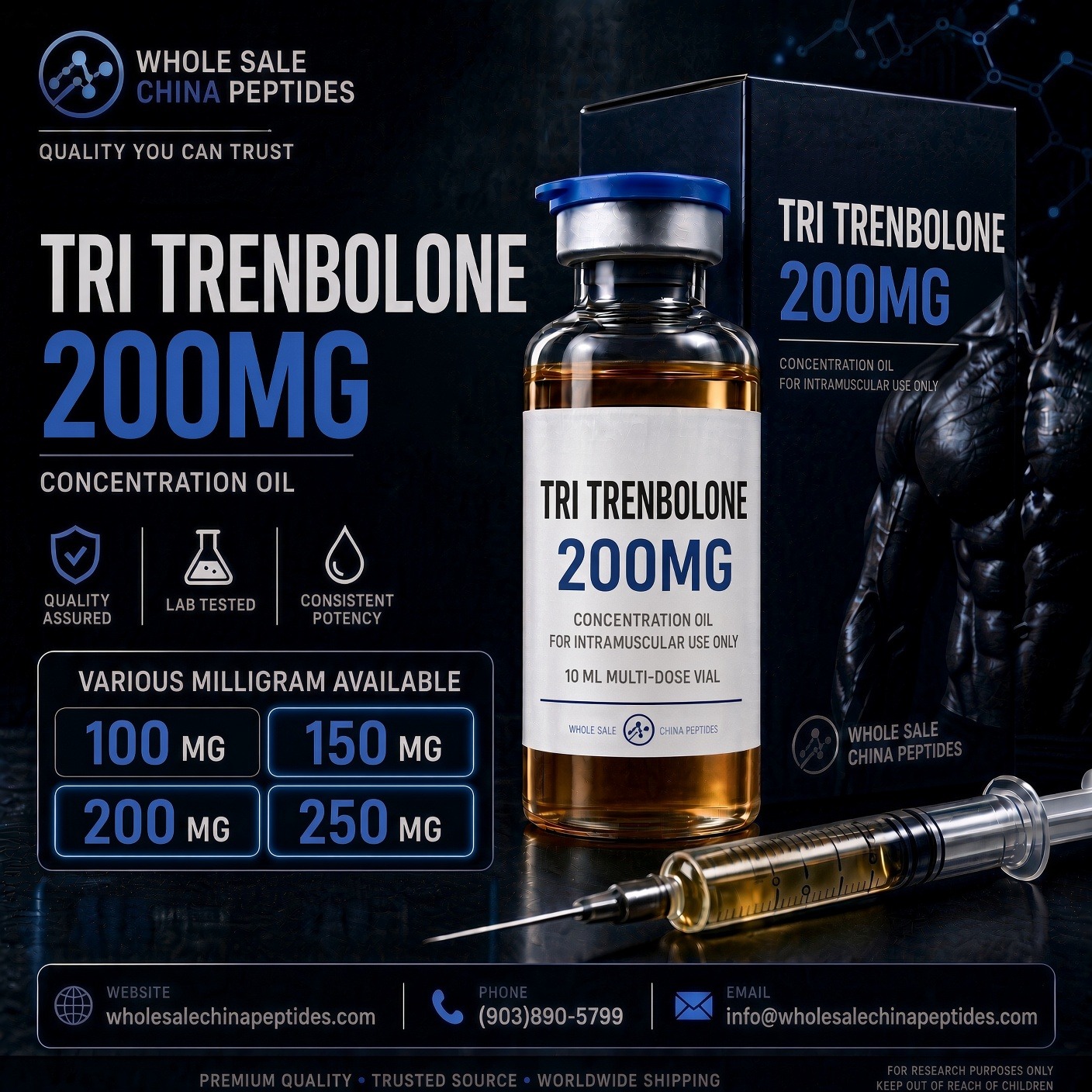
Tri Trenbolone 200mg
Price range: $37.00 through $60.00
Chemical Information and Molecular Structure
To truly understand how tri trenbolone 200mg behaves in laboratory assays and experimental models, one must examine its molecular architecture and the chemistry of esterification across its three components.
1. The Base Molecule (Trenbolone / 19-norandrosta-4,9,11-trien-17beta-ol-3-one)
- Chemical Formula: C18H22O2
- Molecular Weight: 270.37 g/mol
- Core Structure: Trenbolone is a derivative of 19-nortestosterone (nandrolone) featuring additional double bonds at carbon 9 and carbon 11. This unique structural alteration slows its metabolic clearance, prevents aromatization into estrogen, and dramatically increases its binding affinity to the androgen receptor—binding at roughly 5 times the potency of testosterone.
2. The Three Ester Chemistries
- Acetate Ester:
- Chain Type: Acetic acid (2-carbon chain).
- Full Ester Formula: C20H24O3 | Molecular Weight: 312.40 g/mol
- Net Hormone Yield: ~86% active trenbolone.
- Enanthate Ester:
- Chain Type: Heptanoic acid (7-carbon straight-chain carboxylic acid).
- Full Ester Formula: C25H34O3 | Molecular Weight: 382.54 g/mol
- Net Hormone Yield: ~70% active trenbolone.
- Hexahydrobenzylcarbonate Ester:
- Chain Type: Bulky 7-carbon ring-structure carbonate ester.
- Full Ester Formula: C26H34O4 | Molecular Weight: 410.55 g/mol
- Net Hormone Yield: ~66% active trenbolone.
3. Tri-Phase Pharmacokinetic Kinetics
When tri trenbolone 200mg is introduced into a lipid depot, the contrasting ester lengths dictate three distinct release velocities. The acetate portion dissolves rapidly, creating an initial high-concentration wave. Shortly after, the enanthate and hexahydrobenzylcarbonate portions hydrolyze at moderate and slow paces, respectively. This overlapping kinetic profile eliminates the troughs typically seen with single-ester solutions, providing continuous stability.
Comprehensive Guide to Tri Trenbolone 200mg: Multi-Ester Chemistry, Composition, and Wholesale Supply
In the specialized fields of advanced biochemical research, clinical endocrinology, and pharmaceutical formulation, the engineering of innovative pharmacokinetic delivery systems remains at the forefront of scientific exploration. While single-ester compounds dominate standard laboratory protocols, multi-ester and triple-ester blends offer a unique advantage by combining rapid-onset activity with sustained, multi-phase release mechanics. Among these sophisticated formulations, tri trenbolone 200mg stands out as a masterclass in multi-ester synergy.
At Wholesale China Peptides, we specialize in providing high-purity research compounds, raw materials, and professional-grade solutions. Whether you are conducting analytical testing, pharmaceutical compounding, or managing large-scale B2B distribution, understanding the structural science, precise composition, and ester kinetics of tri trenbolone 200mg is essential for maintaining laboratory accuracy.
In this comprehensive guide, we will dive deep into the chemical properties, molecular architecture, triple-ester mechanics, physical traits, and wholesale availability of tri trenbolone 200mg.
What is Tri Trenbolone 200mg?
Tri Trenbolone 200mg is a specialized oil-based injectable solution that blends three distinct esters of the powerful synthetic androgen trenbolone into a single, highly concentrated 200mg/mL matrix.
The core concept behind blending a short ester (acetate), a long ester (enanthate), and an intermediate-to-long ester (hexahydrobenzylcarbonate) mirrors the pharmacological philosophy seen in famous multi-ester blends like Sustanon. When unesterified trenbolone is introduced into biological or experimental models on its own, it clears the bloodstream rapidly. By attaching ester chains to the 17-beta hydroxyl group of the steroid molecule, scientists radically alter its lipid solubility, creating a fat-soluble “depot” upon administration.
Because tri trenbolone 200mg combines three unique ester lengths, local serum and tissue esterases cleave the bonds at different rates. This creates a staggered, tri-phase release profile: an immediate spike in active hormone followed by a prolonged, stable plateau that spans over a week to ten days.
The Precise Composition of Tri Trenbolone 200mg
Formulating a stable, high-purity batch of tri trenbolone 200mg requires absolute precision in solvent chemistry and carrier oil selection. Because trenbolone raw powders carry a heavy molecular load and triple-ester blends have distinct saturation points, the solvent matrix must be meticulously balanced to prevent crystallization (crashing). A standard pharmaceutical-grade 1mL batch of tri trenbolone 200mg typically comprises the following precise ratio of active ingredients and supporting components:
- Active Pharmaceutical Ingredients (API) Totaling 200mg:
- Trenbolone Acetate (50 mg): Provides an immediate surge of active hormone within 24 to 48 hours post-administration.
- Trenbolone Enanthate (100 mg): Bridges the mid-to-long phase, maintaining steady baseline concentrations through the middle of the release cycle.
- Trenbolone Hexahydrobenzylcarbonate (50 mg): The heavy, bulky ester that extends the tail end of the pharmacokinetic curve, sustaining active compound levels for up to 10 days.
- Carrier Oil: A pharmaceutical-grade, low-viscosity lipid vehicle (such as grapeseed oil, fractionated coconut oil/MCT, or sesame oil) that serves as the solvent base and facilitates smooth systemic absorption.
- Cosolvent (Benzyl Benzoate – BB): Essential in high-potency multi-ester formulations like tri trenbolone 200mg to help completely dissolve the heavy concentration of hormone powders into the carrier oil, preventing precipitation at cooler temperatures.
- Preservative/Antimicrobial Agent (Benzyl Alcohol – BA): Typically added at a concentration of 1% to 2% to maintain sterility and protect the vial from microbial contamination during research handling.
Chemical Information and Molecular Structure
To truly understand how tri trenbolone 200mg behaves in laboratory assays and experimental models, one must examine its molecular architecture and the chemistry of esterification across its three components.
1. The Base Molecule (Trenbolone / 19-norandrosta-4,9,11-trien-17beta-ol-3-one)
- Chemical Formula: C18H22O2
- Molecular Weight: 270.37 g/mol
- Core Structure: Trenbolone is a derivative of 19-nortestosterone (nandrolone) featuring additional double bonds at carbon 9 and carbon 11. This unique structural alteration slows its metabolic clearance, prevents aromatization into estrogen, and dramatically increases its binding affinity to the androgen receptor—binding at roughly 5 times the potency of testosterone.
2. The Three Ester Chemistries
- Acetate Ester:
- Chain Type: Acetic acid (2-carbon chain).
- Full Ester Formula: C20H24O3 | Molecular Weight: 312.40 g/mol
- Net Hormone Yield: ~86% active trenbolone.
- Enanthate Ester:
- Chain Type: Heptanoic acid (7-carbon straight-chain carboxylic acid).
- Full Ester Formula: C25H34O3 | Molecular Weight: 382.54 g/mol
- Net Hormone Yield: ~70% active trenbolone.
- Hexahydrobenzylcarbonate Ester:
- Chain Type: Bulky 7-carbon ring-structure carbonate ester.
- Full Ester Formula: C26H34O4 | Molecular Weight: 410.55 g/mol
- Net Hormone Yield: ~66% active trenbolone.
3. Tri-Phase Pharmacokinetic Kinetics
When tri trenbolone 200mg is introduced into a lipid depot, the contrasting ester lengths dictate three distinct release velocities. The acetate portion dissolves rapidly, creating an initial high-concentration wave. Shortly after, the enanthate and hexahydrobenzylcarbonate portions hydrolyze at moderate and slow paces, respectively. This overlapping kinetic profile eliminates the troughs typically seen with single-ester solutions, providing continuous stability.
Physical Properties of Tri Trenbolone 200mg Solutions
For laboratory technicians, compounders, and wholesale buyers, recognizing the physical characteristics of high-purity tri trenbolone 200mg is critical for quality control:
- Appearance: A clear, deep amber to dark golden oil solution. (Trenbolone raw solutions naturally exhibit a characteristic dark yellow/amber hue due to the conjugated double bond system). It should be entirely free from suspended particulates, haze, or crystal sedimentation.
- Viscosity: Moderate. Because the formulation packs a balanced 200mg total load per milliliter utilizing triple esters, the fluid flows smoothly through laboratory filtration and extraction tools when kept at controlled room temperatures.
- Solubility: Insoluble in water; highly soluble in organic solvents, alcohols, and lipid/oil matrices.
- Storage Recommendations: Store at controlled room temperatures (20°C to 25°C). Protect tri trenbolone 200mg from prolonged exposure to direct UV light and extreme cold, which can cause high-potency hormone solutions to crash or precipitate out of the carrier oil matrix.
Why Source Multi-Ester Blends from Wholesale China Peptides?
Navigating the global marketplace for research chemicals, raw powders, and specialized finished oil solutions requires absolute confidence in your supply chain. At Wholesale China Peptides, we bridge the gap between advanced biochemical manufacturing and rigorous quality assurance.
When you partner with us for your tri trenbolone 200mg supply needs, you gain access to:
- Stringent HPLC Assay Testing: Every batch of tri trenbolone 200mg undergoes High-Performance Liquid Chromatography testing to verify precise milligram ratios, molecular integrity, and purity levels exceeding 99%.
- Secure and Discrete Global Logistics: Specialized packaging solutions designed to protect fragile glass vials, maintain temperature control, and ensure safe international delivery.
- Unmatched B2B Value: Direct wholesale pricing structures tailored specifically for laboratories, research institutions, and commercial distributors looking for scalable, reliable supply chains.
Frequently Asked Questions (FAQs)
1. What are the benefits of using a blend like tri trenbolone 200mg?
The primary advantage is tri-phase kinetic delivery. By combining the fast-acting acetate ester (immediate release), the enanthate ester (steady mid-phase release), and the hexahydrobenzylcarbonate ester (prolonged tail release), researchers achieve comprehensive pharmacokinetic coverage from a single administration.
2. Is tri trenbolone 200mg water-soluble?
No. Tri trenbolone 200mg is an oil-based formulation. The trenbolone molecules are esterified to become lipophilic (fat-soluble) and are suspended in a carrier oil to create a controlled-release depot effect when introduced to lipid-rich environments.
3. How can I purchase wholesale tri trenbolone products?
You can review our product catalog, verify batch specifications, and place bulk wholesale orders directly through our secure platform at https://wholesalechinapeptides.com/. For specialized custom manufacturing or bulk inquiries, please contact our customer support team directly.
Conclusion
The engineering of stable, high-potency multi-ester hormone solutions requires meticulous attention to organic chemistry, solvent ratios, and precision manufacturing. Tri trenbolone 200mg remains an exceptional, highly efficient compound for modern biochemical research and pharmaceutical compounding where complex release kinetics are required.
Trust Wholesale China Peptides as your premier B2B partner for certified research compounds and specialized formulations. Visit our website today to explore our comprehensive inventory and secure your high-purity tri trenbolone 200mg supply.
| Choose An Option | 10ML, 20ML |
|---|
Be the first to review “Tri Trenbolone 200mg”
Related products

OIL
Reviews
There are no reviews yet.