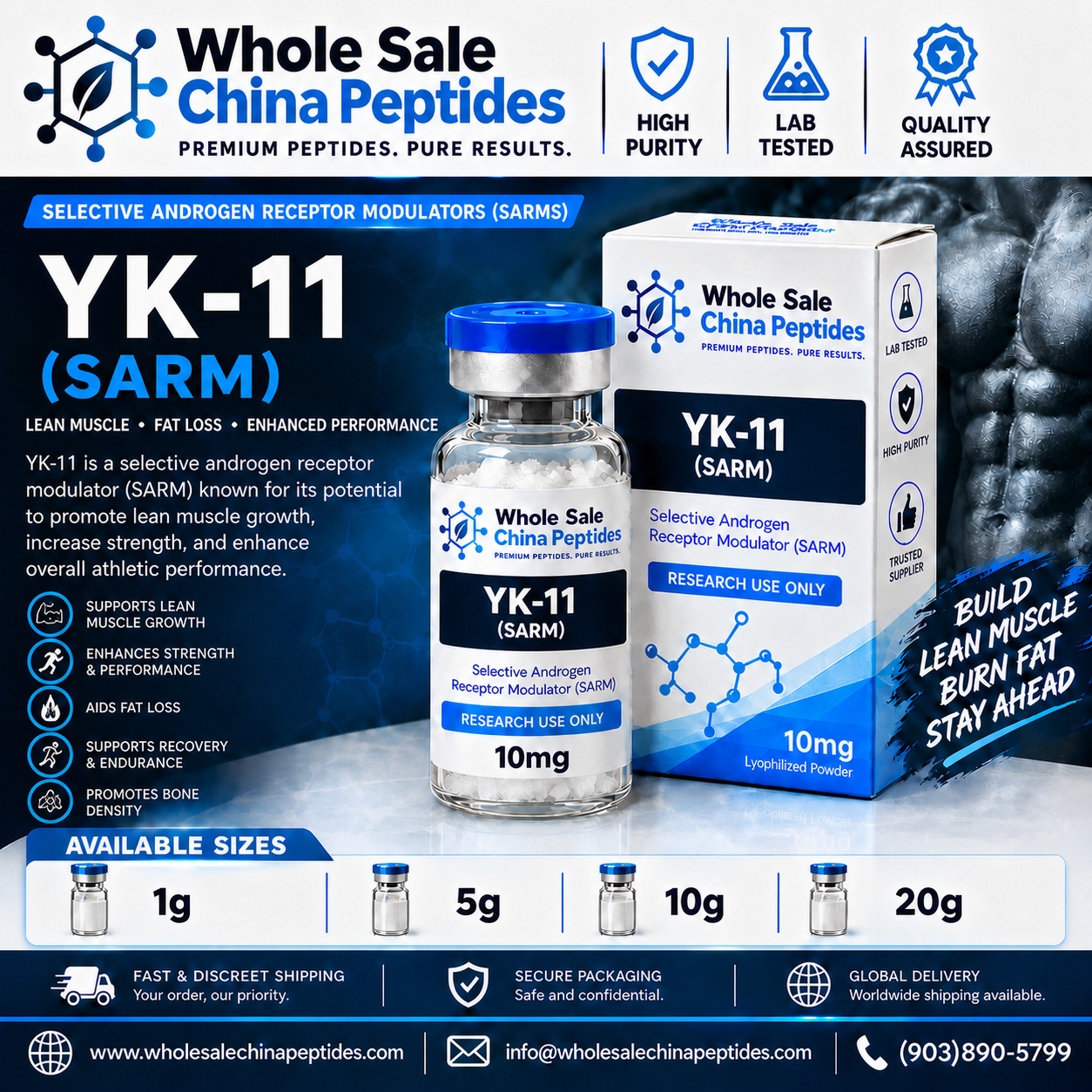
YK-11
Price range: $230.00 through $2,000.00
Comprehensive Chemical Information and Composition
Formulating a stable, high-purity batch of YK-11 requires absolute precision in organic synthesis, stereochemical control, and analytical verification. Whether supplied as raw crystalline powder or prepared as a standardized research solution, understanding its exact chemical identity is paramount for laboratory quality control.
Molecular and Chemical Specifications:
- International Nonproprietary Name / Research Identifier: YK-11, YK11
- IUPAC Chemical Name: Methyl (20S)-17,20-isopropylidenedioxy-3-oxo-19-norpregna-1,4-dien-21-carboxylate (Also referenced structurally as a 17-alpha-methyl-19-nortestosterone derivative modified with a 21-ester side chain).
- Base Chemical Formula: C25H34O4
- Molecular Weight: 398.54 g/mol
- Purity Standards: Exceeding 99% verified via High-Performance Liquid Chromatography (HPLC) and Mass Spectrometry (MS).
- Physical State: Fine crystalline powder, white to pale off-white in color.
Core Structural Features
The chemical architecture of YK-11 is characterized by a modified 19-nortestosterone (nandrolone) steroidal backbone. However, unlike traditional steroids or standard SARMs, YK-11 features two monumental structural modifications that completely alter its biological activity:
- C17-alpha Methylation: Like many orally bioavailable androgens, YK-11 possesses a methyl group at the 17th carbon position, protecting the molecule from immediate first-pass hepatic degradation and allowing for stable oral or systemic experimental delivery.
- The Unique Carbon-21 Ester Side Chain: The most defining structural feature of YK-11 is the addition of a specific carbon-21 ester group (specifically a 17,20-isopropylidenedioxy group). This chemical appendage is what transforms a standard steroidal backbone into a tissue-selective ligand capable of inducing the cellular machinery to upregulate follistatin.
The presence of these functional groups creates strong electrostatic and hydrophobic interactions within the ligand-binding domain of the androgen receptor while simultaneously unlocking non-genomic transcription pathways that inhibit myostatin production. High-purity synthesis requires stringent stereochemical control to ensure the 20S spatial orientation remains uncompromised.
Comprehensive Master Guide to YK-11: Molecular Architecture, Myostatin Inhibition, and Wholesale Supply
In the sophisticated landscape of advanced biochemical research, endocrinology studies, and cutting-edge pharmaceutical development, Selective Androgen Receptor Modulators (SARMs) and synthetic myogenesis regulators have fundamentally transformed the paradigm of non-steroidal and hybrid ligand design. Traditional anabolic-androgenic agents have long presented researchers with a significant pharmacological paradox: while they successfully promote skeletal muscle hypertrophy, nitrogen retention, and osteogenic activity, their lack of tissue specificity frequently induces undesirable off-target systemic side effects, particularly in prostate, cardiovascular, and sebaceous tissues.
To overcome these structural limitations, modern medicinal chemistry engineered a new class of compounds designed to selectively activate androgen receptors in targeted tissues while simultaneously exploring genetic pathways that bypass traditional receptor bottlenecks. Among this elite group of experimental molecules, YK-11 stands out as one of the most structurally unique, scientifically fascinating, and potent hybrid compounds in modern scientific literature—functioning simultaneously as a selective androgen receptor ligand and a powerful myostatin inhibitor via follistatin upregulation.
At Wholesale China Peptides, we pride ourselves on being a premier global supplier of certified research compounds, raw materials, and professional-grade specialized solutions. Whether your laboratory is engaged in advanced chromatographic analysis, endocrine receptor binding assays, myostatin-follistatin kinetic studies, or large-scale B2B distribution, understanding the structural science, precise composition, pharmacokinetic profile, and synthesis standards of YK-11 is essential for maintaining absolute experimental accuracy.
In this comprehensive, exhaustive technical guide, we will dive deep into the molecular architecture, chemical properties, dual-action pharmacodynamics, physical traits, formulation standards, and wholesale availability of YK-11.
1. What is YK-11?
YK-11 is an orally active, synthetic experimental compound first discovered and investigated by Japanese researcher Dr. Yuichiro Kanno in 2011. While frequently commercialized and categorized alongside Selective Androgen Receptor Modulators (SARMs) in research chemical catalogs due to its tissue-selective profile, YK-11 occupies a distinct structural and functional category: it is a synthetic steroid-derived hybrid molecule that acts as both a partial androgen receptor agonist and a genetic regulator of myostatin.
To fully appreciate the significance of YK-11 in laboratory research, one must understand its developmental purpose. Conventional testosterone replacement therapies and synthetic anabolic steroids stimulate androgen receptors uniformly across every tissue type in the body, while also hitting a biological ceiling imposed by the body’s natural muscle-limiting proteins. YK-11 was engineered specifically to explore dual-action myogenesis—stimulating robust anabolic signaling in skeletal muscle and bone tissue while actively suppressing myostatin, a myokine that normally places a strict genetic brake on muscle growth.
Because of its unique chemical scaffold—derived from a 19-nortestosterone backbone modified with a specific carbon-21 ester group—YK-11 achieves an extraordinarily high binding affinity and unique dual-action mechanism, making it a premier subject of study in cellular hypertrophy, muscular dystrophy modeling, and targeted receptor pharmacology.
2. Comprehensive Chemical Information and Composition
Formulating a stable, high-purity batch of YK-11 requires absolute precision in organic synthesis, stereochemical control, and analytical verification. Whether supplied as raw crystalline powder or prepared as a standardized research solution, understanding its exact chemical identity is paramount for laboratory quality control.
Molecular and Chemical Specifications:
- International Nonproprietary Name / Research Identifier: YK-11, YK11
- IUPAC Chemical Name: Methyl (20S)-17,20-isopropylidenedioxy-3-oxo-19-norpregna-1,4-dien-21-carboxylate (Also referenced structurally as a 17-alpha-methyl-19-nortestosterone derivative modified with a 21-ester side chain).
- Base Chemical Formula: C25H34O4
- Molecular Weight: 398.54 g/mol
- Purity Standards: Exceeding 99% verified via High-Performance Liquid Chromatography (HPLC) and Mass Spectrometry (MS).
- Physical State: Fine crystalline powder, white to pale off-white in color.
Core Structural Features
The chemical architecture of YK-11 is characterized by a modified 19-nortestosterone (nandrolone) steroidal backbone. However, unlike traditional steroids or standard SARMs, YK-11 features two monumental structural modifications that completely alter its biological activity:
- C17-alpha Methylation: Like many orally bioavailable androgens, YK-11 possesses a methyl group at the 17th carbon position, protecting the molecule from immediate first-pass hepatic degradation and allowing for stable oral or systemic experimental delivery.
- The Unique Carbon-21 Ester Side Chain: The most defining structural feature of YK-11 is the addition of a specific carbon-21 ester group (specifically a 17,20-isopropylidenedioxy group). This chemical appendage is what transforms a standard steroidal backbone into a tissue-selective ligand capable of inducing the cellular machinery to upregulate follistatin.
The presence of these functional groups creates strong electrostatic and hydrophobic interactions within the ligand-binding domain of the androgen receptor while simultaneously unlocking non-genomic transcription pathways that inhibit myostatin production. High-purity synthesis requires stringent stereochemical control to ensure the 20S spatial orientation remains uncompromised.
3. Mechanism of Action: Dual-Action Myogenesis (AR Agonism + Myostatin Suppression)
The primary scientific interest surrounding YK-11 lies in its unprecedented dual-action pharmacodynamic mechanism. While most anabolic agents rely solely on androgen receptor (AR) agonism, YK-11 operates via two completely independent biochemical pathways simultaneously.
Pathway 1: Tissue-Selective Androgen Receptor Agonism
When YK-11 enters systemic circulation, it crosses cellular membranes and binds specifically to androgen receptors located in target tissues. Upon binding, the molecule undergoes conformational changes that recruit specific co-activator proteins while discouraging the recruitment of co-repressors.
This selective recruitment initiates gene transcription pathways that drive protein synthesis, nitrogen retention, and cellular hypertrophy primarily in skeletal muscle and osteogenic (bone) cells. In standard in vitro binding assays utilizing C2C12 myoblast cells (mouse muscle cells), YK-11 demonstrates an exceptionally high relative binding affinity for the AR, outperforming many standard synthetic androgens while maintaining a tissue-selective profile that minimizes prostate and sebaceous stimulation.
Pathway 2: Myostatin Inhibition via Follistatin Upregulation
The true scientific marvel of YK-11—and the feature that separates it from every standard SARM or steroid—is its profound interaction with myostatin.
- What is Myostatin? Myostatin (also known as growth differentiation factor 8 or GDF-8) is a myokine (a protein produced by skeletal muscle cells) that acts as a negative regulator of skeletal muscle mass. In biological terms, myostatin places a strict genetic “ceiling” on how much muscle tissue an organism can develop, preventing excessive and metabolically burdensome hypertrophy. Animals and humans with genetic mutations that block myostatin exhibit dramatic, extreme muscle hypertrophy (the famous “double-muscled” phenotype observed in Belgian Blue cattle and certain human genetic variants).
- The Role of YK-11: In groundbreaking cellular research conducted by Dr. Yuichiro Kanno, muscle cells treated with YK-11 produced significantly more anabolic proteins than cells treated with testosterone alone. Crucially, Kanno’s research revealed that YK-11 acts as a powerful myostatin inhibitor.
- The Follistatin Mechanism: YK-11 does not bind directly to the myostatin protein to neutralize it. Instead, it triggers the muscle cells to massively upregulate the production of Follistatin, a potent endogenous myostatin-binding protein. By flooding the cellular environment with follistatin, YK-11 binds up and neutralizes circulating myostatin.
- Breaking the Genetic Ceiling: By neutralizing myostatin via follistatin upregulation, YK-11 effectively removes the biological brake on muscle growth. This allows skeletal muscle cells to synthesize protein and proliferate far beyond normal physiological limitations, making YK-11 a monumental subject of study in muscular dystrophy and severe muscle-wasting research.
Absence of Aromatization
Because YK-11 is a modified 19-nor derivative with specialized ester attachments, it possesses zero chemical affinity for the aromatase enzyme. It cannot convert into estrogen under any metabolic circumstances. Consequently, experimental models utilizing YK-11 will never experience estrogenic side effects, providing a pristine environment for studying pure, unadulterated androgen receptor signaling and myostatin suppression.
4. Pharmacokinetics and Systemic Dynamics
Understanding the pharmacokinetic profile of YK-11 is essential for designing accurate experimental protocols and analytical assays.
Oral Bioavailability and Absorption
Due to its C17-alpha methylation, YK-11 exhibits good oral bioavailability, resisting rapid degradation in the gastrointestinal tract and entering systemic circulation efficiently following oral ingestion. In laboratory settings, it is frequently dissolved in polar organic solvents such as DMSO, polyethylene glycol (PEG), or high-purity ethanol for liquid experimental distribution.
Plasma Half-Life and Duration of Action
The terminal elimination half-life of YK-11 is relatively short, typically estimated between 6 to 10 hours.
Due to this short-to-moderate half-life, experimental protocols typically utilize split-dosing strategies (administering the compound twice daily) to maintain stable, uninterrupted plasma concentrations and continuous receptor occupancy throughout a 24-hour cycle. This split-dosing schedule ensures consistent analytical data across multi-week experimental timeframes.
5. Key Research Applications and Investigative Frameworks
In the realm of advanced biochemical and endocrinological research, YK-11 is investigated across a wide spectrum of physiological models:
- Myogenesis and Extreme Hypertrophy Models: Researchers frequently utilize YK-11 in advanced myogenesis models to study the synergistic effects of simultaneous androgen receptor activation and myostatin suppression via the follistatin pathway.
- Muscular Dystrophy and Wasting Disease Models: Because myostatin overexpression is a primary driver of degenerative muscle-wasting conditions (such as Duchenne muscular dystrophy and cachexia), YK-11 is studied extensively for its ability to overcome genetic wasting mechanisms and stimulate functional protein synthesis.
- Bone Mineral Density and Osteogenesis: Due to its robust anabolic action on osteoblasts and its structural classification as an androgen receptor ligand, YK-11 is studied in bone fracture healing and osteoporosis models to evaluate improvements in bone mineral density and cortical thickness.
- Cellular Signaling and Myokine Interaction: Molecular biologists utilize YK-11 as a foundational research tool to map the precise gene transcription cascades that link C2C12 myoblast proliferation with follistatin upregulation, offering deeper insights into human muscle physiology.
6. Physical Properties and Quality Control Standards
For laboratory technicians, analytical chemists, and wholesale buyers, recognizing the physical characteristics and quality control benchmarks of high-purity YK-11 is critical for experimental validation:
- Appearance: A fine, white to pale off-white crystalline powder (when supplied as raw API) or a clear, homogenous solution (when compounded into research liquids). It should be entirely free from discoloration, clumping, or foreign particulate matter.
- Solubility: Insoluble in water; highly soluble in polar organic solvents such as DMSO (Dimethyl sulfoxide), Ethanol, and Polyethylene Glycol (PEG 400), making it exceptionally easy to reconstitute for laboratory assays and liquid research formulations.
- Storage Recommendations: Store dry powder in a cool, dark environment (controlled room temperature between 20°C to 25°C) protected from moisture and direct UV light. Reconstituted liquid solutions should be kept refrigerated (2°C to 8°C) to maintain long-term molecular stability.
- Analytical Verification: Every production lot of YK-11 supplied by Wholesale China Peptides undergoes mandatory High-Performance Liquid Chromatography (HPLC) and Mass Spectrometry (MS) testing to verify that molecular identity, isomeric purity, and overall purity levels exceed 99%.
7. Why Source YK-11 from Wholesale China Peptides?
Navigating the global marketplace for advanced research chemicals, raw SARMs, and specialized hybrid compounds requires an uncompromising commitment to supply chain integrity. Inferior synthesis, incorrect stereochemistry, or contaminated powders can compromise months of laboratory research and invalidate chromatographic data.
When you partner with Wholesale China Peptides for your YK-11 supply needs, you gain access to an elite tier of B2B manufacturing excellence:
- Certified Laboratory Purity: All our raw powders and formulated solutions are backed by verifiable HPLC and MS certificates of analysis, ensuring absolute precision in molecular structure, chiral purity, and overall purity exceeding 99%.
- Advanced Synthesis & Quality Assurance: Produced in state-of-the-art chemical synthesis environments utilizing strict stereochemical control, rigorous crystallization techniques, and comprehensive batch testing.
- Secure, Discrete Global Logistics: We understand the sensitive nature of international research supply chains. Our specialized packaging solutions are engineered to protect delicate compounds, maintain thermal stability, and ensure seamless customs clearance worldwide.
- Scalable Wholesale Pricing: Whether you are an independent research institution, a compounding laboratory, or a large-scale distributor, our direct-to-consumer B2B pricing structures offer unmatched economic value without ever compromising on quality.
8. Frequently Asked Questions (FAQs)
1. Is YK-11 technically a SARM or a steroid?
YK-11 occupies a hybrid structural classification. While it is chemically derived from a 19-nortestosterone (steroid) backbone, it functions pharmacologically with the tissue-selective profile of a Selective Androgen Receptor Modulator (SARM). Furthermore, its unique carbon-21 ester side chain grants it myostatin-inhibiting properties that traditional SARMs and steroids do not possess.
2. How does YK-11 inhibit myostatin?
YK-11 does not bind directly to the myostatin protein. Instead, it acts as a genetic regulator that instructs skeletal muscle cells to massively upregulate the production of Follistatin, a powerful endogenous protein that binds to and neutralizes circulating myostatin, effectively removing the genetic ceiling on muscle growth.
3. What is the active half-life of YK-11 in research models?
The terminal elimination half-life of YK-11 is relatively short, ranging between 6 to 10 hours. Due to this moderate half-life, experimental protocols frequently utilize split-dosing strategies (administered twice daily) to maintain stable, continuous plasma concentrations.
4. How can I place a wholesale order for YK-11?
You can review our product catalog, examine batch specifications, and place secure bulk wholesale orders directly through our official platform at https://wholesalechinapeptides.com/. For specialized custom synthesis, bulk institutional pricing, or specific HPLC documentation requests, please reach out directly to our customer support and sales engineering team.
Conclusion
The exploration of advanced hybrid ligands and myostatin inhibitors requires meticulous adherence to chemical purity, precise structural synthesis, and uncompromising manufacturing standards. YK-11 remains an unrivaled, essential benchmark for modern biochemical research, endocrinology studies, and myogenesis investigations where dual-action androgen receptor agonism and follistatin upregulation are required.
Trust Wholesale China Peptides as your premier B2B partner for certified research compounds, advanced SARMs, and specialized formulations. Visit our website today to explore our comprehensive inventory, review our analytical testing reports, and secure your high-purity YK-11 supply.

| Choose An Option | 10G, 100G |
|---|
Be the first to review “YK-11”
Related products
SARMS
SARMS

SARMS

SARMS
SARMS

SARMS

SARMS
Reviews
There are no reviews yet.