

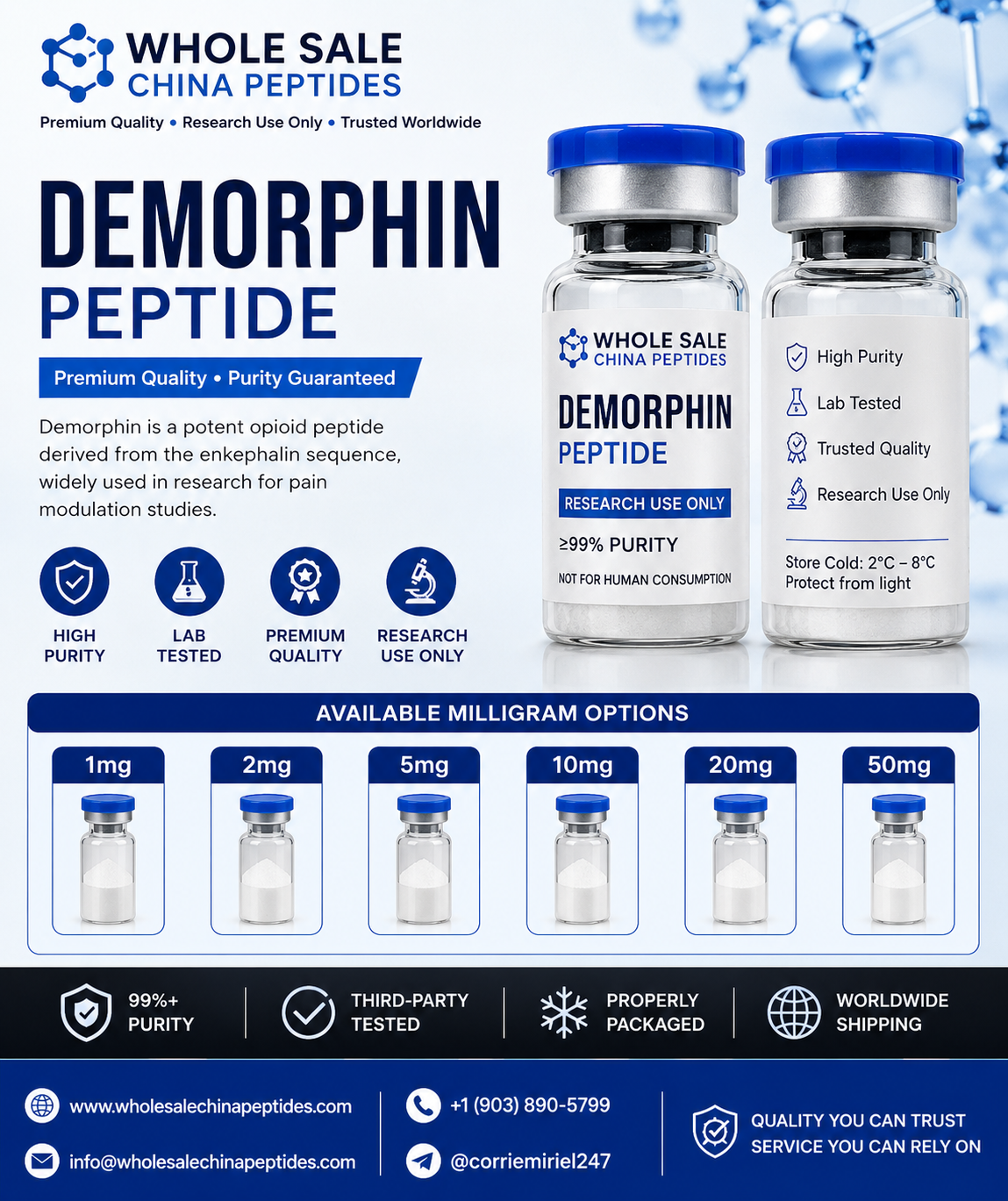
Demorphin Peptide
Price range: $70.00 through $280.00
Demorphin Peptide: Chemical Composition & Structure
Molecular Formula:
C₄₆H₆₃N₉O₁₀S₂
Molecular Weight:
942.16 g/mol
Amino Acid Sequence:
Tyr-D-Met-Phe-His-Leu-Met-Asp-NH₂
Key Structural Features:
- Heptapeptide (7 amino acids) – Small size allows for rapid absorption and brain penetration
- D-methionine (D-Met) residue – Enhances stability and resistance to enzymatic degradation
- Amidated C-terminus (Asp-NH₂) – Improves receptor binding affinity and biological activity
- Aromatic residues (Tyr, Phe, His) – Critical for δ-opioid receptor binding
- Hydrophobic and polar residues – Balance receptor interaction and solubility
Chemical Properties:
| Property | Details |
|---|---|
| Solubility | Water-soluble (reconstitute with bacteriostatic water) |
| Storage (Lyophilized) | -20°C (stable for 2+ years) |
| Storage (Reconstituted) | 2-8°C (stable for 7-14 days) |
| Half-Life | ~30-60 minutes (IV), ~2-4 hours (SC) |
| Purity | ≥98% (HPLC-verified) |
Demorphin Peptide: A Comprehensive Research Guide to Natural Opioid Analgesics
Introduction to Demorphin Peptide
Demorphin is a naturally occurring heptapeptide first isolated from the skin secretions of South American frogs (Phyllomedusa species). This powerful opioid peptide has gained significant attention in pain research, neuropharmacology, and opioid receptor studies due to its exceptional potency and selectivity for δ-opioid receptors (DOR).
At Wholesale China Peptides, researchers can access high-purity demorphin peptide for controlled laboratory studies. This 1000+ word guide covers everything scientists need to know about demorphin, including its chemical composition, mechanisms of action, research benefits, dosage protocols, and safety considerations.
What Is Demorphin Peptide?
Demorphin is a heptapeptide (7 amino acids) with the sequence Tyr-D-Met-Phe-His-Leu-Met-Asp-NH₂. It is one of the most potent natural δ-opioid receptor agonists known, with analgesic effects comparable to morphine but with different receptor selectivity and side effect profiles.
Key Features of Demorphin:
✅ Highly selective for δ-opioid receptors (DOR) – 100-1000x more selective than morphine
✅ Potent analgesic effects – Comparable to morphine in pain models
✅ Natural origin – Produced by Phyllomedusa frogs (e.g., Phyllomedusa bicolor)
✅ Resistant to enzymatic degradation – D-methionine (D-Met) enhances stability
✅ Reduced side effects – Lower risk of respiratory depression and constipation compared to μ-opioids
✅ Potential for reduced tolerance – Different receptor profile may lead to slower tolerance development
Demorphin Peptide Benefits in Research
Demorphin is studied for its potential therapeutic applications in multiple fields:
1. Pain Research & Analgesia
- Chronic pain management – Effective in neuropathic and inflammatory pain models
- Acute pain treatment – Provides rapid and potent pain relief
- Opioid-induced hyperalgesia (OIH) – Investigates pain sensitization mechanisms
- Post-surgical pain – Reduces pain and opioid requirements after surgery
2. Opioid Pharmacology & Receptor Studies
- δ-opioid receptor (DOR) research – Highly selective DOR agonist
- Opioid receptor subtype studies – Helps differentiate DOR, MOR, and KOR effects
- Tolerance and dependence mechanisms – Investigates opioid tolerance development
- Opioid rotation studies – Explores alternatives to μ-opioid analgesics
3. Neuropharmacology & Neuroscience
- Neurotransmitter modulation – Affects dopamine, serotonin, and GABA systems
- Neuroprotection – Protects against ischemic and excitotoxic damage
- Neuroinflammation – Reduces pro-inflammatory cytokines in the CNS
- Neurodegenerative disease models – Studied in Alzheimer’s and Parkinson’s research
4. Addiction & Substance Abuse Research
- Opioid addiction models – Investigates reward pathways and dependence
- Opioid withdrawal – Alleviates withdrawal symptoms in animal models
- Alternative pain management – Potential opioid-sparing agent for addiction prevention
5. Gastrointestinal & Motility Research
- Gut motility modulation – Affects intestinal transit and secretion
- Irritable bowel syndrome (IBS) – Studied for visceral pain and motility disorders
- Opioid-induced constipation (OIC) – Investigates peripheral vs. central effects
Demorphin Peptide: Chemical Composition & Structure
Molecular Formula:
C₄₆H₆₃N₉O₁₀S₂
Molecular Weight:
942.16 g/mol
Amino Acid Sequence:
Tyr-D-Met-Phe-His-Leu-Met-Asp-NH₂
Key Structural Features:
- Heptapeptide (7 amino acids) – Small size allows for rapid absorption and brain penetration
- D-methionine (D-Met) residue – Enhances stability and resistance to enzymatic degradation
- Amidated C-terminus (Asp-NH₂) – Improves receptor binding affinity and biological activity
- Aromatic residues (Tyr, Phe, His) – Critical for δ-opioid receptor binding
- Hydrophobic and polar residues – Balance receptor interaction and solubility
Chemical Properties:
| Property | Details |
|---|---|
| Solubility | Water-soluble (reconstitute with bacteriostatic water) |
| Storage (Lyophilized) | -20°C (stable for 2+ years) |
| Storage (Reconstituted) | 2-8°C (stable for 7-14 days) |
| Half-Life | ~30-60 minutes (IV), ~2-4 hours (SC) |
| Purity | ≥98% (HPLC-verified) |
How Demorphin Works: Mechanisms of Action
Demorphin exerts its effects primarily through activation of δ-opioid receptors (DOR), which are G-protein-coupled receptors (GPCRs) expressed in the central and peripheral nervous systems. This activation triggers a cascade of intracellular signaling pathways that mediate its analgesic and pharmacological effects.
1. Opioid Receptor Binding & Activation
- DOR binding – Demorphin binds to δ-opioid receptors with high affinity
- G-protein activation – Triggers Gi/o protein signaling
- Adenylate cyclase inhibition – Reduces cAMP production
- Ion channel modulation – Opens K⁺ channels and closes Ca²⁺ channels
- Neuronal hyperpolarization – Inhibits neurotransmitter release and pain signaling
2. Analgesic Effects
- Spinal analgesia – Inhibits pain transmission in the dorsal horn
- Supraspinal analgesia – Activates descending pain inhibitory pathways
- Peripheral analgesia – Reduces inflammatory pain at injury sites
3. Neurotransmitter Modulation
- Dopamine release – Enhances reward and motivation pathways
- Serotonin modulation – Affects mood and emotional responses
- GABAergic effects – Enhances inhibitory neurotransmission
4. Neuroprotective Effects
- Reduces oxidative stress – Scavenges reactive oxygen species (ROS)
- Inhibits neuroinflammation – Lowers pro-inflammatory cytokines (TNF-α, IL-6, IL-1β)
- Protects against excitotoxicity – Prevents glutamate-induced neuronal damage
5. Gastrointestinal Effects
- Slows gastric emptying – Affects gut motility
- Reduces intestinal secretion – Modulates fluid and electrolyte balance
- Inhibits peristalsis – Contributes to opioid-induced constipation (OIC)
Demorphin Peptide Dosage Protocols for Research
Since demorphin is not approved for human use, dosage guidelines are based on preclinical and research models. Researchers should adjust protocols based on study objectives.
General Dosage Guidelines
| Study Type | Dosage Range | Administration Route | Frequency | Study Duration |
|---|---|---|---|---|
| Analgesia Research | 0.1-10 mcg/kg | Intravenous (IV), Subcutaneous (SC), or Intrathecal (IT) | Single dose or repeated | As needed |
| Opioid Receptor Studies | 0.1-5 mcg/kg | IV, SC, or Intracerebroventricular (ICV) | Single dose | As needed |
| Neuropharmacology Research | 0.5-10 mcg/kg | IV, SC, or IP | Single dose or repeated | 1-14 days |
| Addiction Research | 1-20 mcg/kg | IV or SC | Repeated (as needed) | 7-28 days |
| Gastrointestinal Research | 0.1-5 mcg/kg | IV or SC | Single dose or repeated | 1-7 days |
Key Dosage Considerations
✔ Start with low doses (0.1-1 mcg/kg) to assess analgesic efficacy and side effects
✔ Monitor respiratory function in high-dose studies
✔ Use intrathecal administration for spinal analgesia studies
✔ Combine with opioid antagonists (e.g., naltrindole for DOR specificity) to study receptor selectivity
✔ Cycle demorphin to prevent tolerance development
Potential Side Effects & Safety Considerations
While demorphin is generally well-tolerated in research, potential side effects should be monitored:
Common Side Effects (Observed in Animal Models)
| Side Effect | Cause | Mitigation Strategy |
|---|---|---|
| Respiratory depression | Central DOR activation | Monitor respiratory rate, use lower doses |
| Sedation | CNS depression | Administer in controlled environments |
| Constipation | Gastrointestinal DOR activation | Monitor gut motility, use peripheral antagonists |
| Nausea/vomiting | Chemoreceptor trigger zone activation | Administer with antiemetics if needed |
| Tolerance development | Receptor desensitization | Use intermittent dosing, monitor efficacy |
Long-Term Considerations
⚠ Dependence and withdrawal – Monitor for physical dependence with prolonged use
⚠ Opioid-induced hyperalgesia (OIH) – May increase pain sensitivity over time
⚠ Hormonal effects – May affect cortisol, testosterone, or prolactin levels
⚠ Drug interactions – May enhance effects of other CNS depressants or opioids
Where to Buy High-Quality Demorphin Peptide for Research
For researchers seeking pharmaceutical-grade demorphin peptide, Wholesale China Peptides offers:
✅ ≥98% Purity (HPLC-verified)
✅ Lyophilized for long-term stability
✅ Batch-specific COAs (Certificate of Analysis)
✅ Bulk & wholesale pricing for institutions
✅ Secure, discreet shipping worldwide
Note: Demorphin peptide is for research use only—not for human consumption, medical treatment, or performance enhancement.
Conclusion: Why Demorphin Peptide is a Game-Changer in Pain & Opioid Research
Demorphin is one of the most potent and selective natural δ-opioid agonists available for pain research and opioid pharmacology. Its exceptional affinity for δ-opioid receptors, reduced side effect profile, and natural origin make it a valuable tool for studying:
✔ Pain mechanisms and analgesia (acute, chronic, neuropathic pain)
✔ Opioid receptor pharmacology (DOR, MOR, KOR selectivity)
✔ Neuropharmacology and neurotransmitter modulation (dopamine, serotonin, GABA)
✔ Addiction and substance abuse (reward pathways, dependence, withdrawal)
✔ Gastrointestinal effects of opioids (motility, secretion, OIC)
For researchers looking to advance pain, opioid, and neuropharmacology studies, Wholesale China Peptides provides high-purity demorphin peptide at competitive prices.
Disclaimer: This article is for educational and research purposes only. Demorphin peptide is not approved for human use and should only be used in IRB-approved laboratory settings.
Ready to Advance Your Pain & Opioid Research with Demorphin?
🔹 Visit Wholesale China Peptides
🔹 Request a COA before purchasing
🔹 Consult with a research advisor for proper dosing protocols
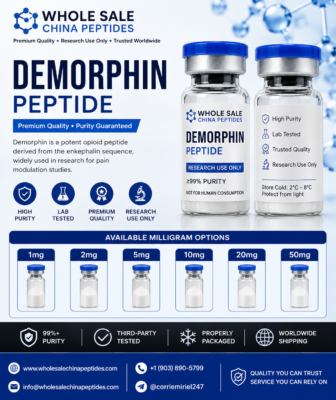
demorphin peptide
| Choose An Option | 2mg*10vials, 5mg*10vials, 10mg*10vials |
|---|
Be the first to review “Demorphin Peptide”
Related products

Healing & Recovery Peptides

Cognitive & Neurological Research Peptides

Healing & Recovery Peptides

Healing & Recovery Peptides

GLP-1 & Metabolic Research Peptides
Cognitive & Neurological Research Peptides

Growth Hormone Secretagogues

Healing & Recovery Peptides
Reviews
There are no reviews yet.